

FUT vs. FUE Hair Transplant: What’s the Difference?

Hair transplant is a safe and effective procedure for permanently addressing hair loss. For patients seeking natural, lasting results, two advanced techniques dominate modern hair restoration: Follicular Unit Transplantation (FUT) and Follicular Unit Extraction (FUE).
While both methods address hair loss in a similar manner (by relocating healthy, DHT-resistant hair follicles from donor areas to bald areas of the scalp), there are some major differences between FUT and FUE.
Understanding Hair Transplants
A hair transplant is a permanent hair restoration procedure where hair from fuller areas is used to address areas experiencing moderate to severe hair thinning. Regardless of whether an FUE or FUT technique is used, all hair transplants share one principle: redistributing genetically resistant hair follicles from the donor area (typically the back or sides of the scalp) to thinning or balding areas (the recipient area).
Transplanted follicles continue their normal hair growth cycles, shedding briefly after surgery before producing new, permanent hairs. The final result is new hair growth that blends into existing hair due to its natural density, direction, and texture.
When performed by a skilled surgeon, modern hair restoration produces natural, permanent coverage that restores both hair and confidence.
What Is FUT (Follicular Unit Transplantation)?
Procedure Overview
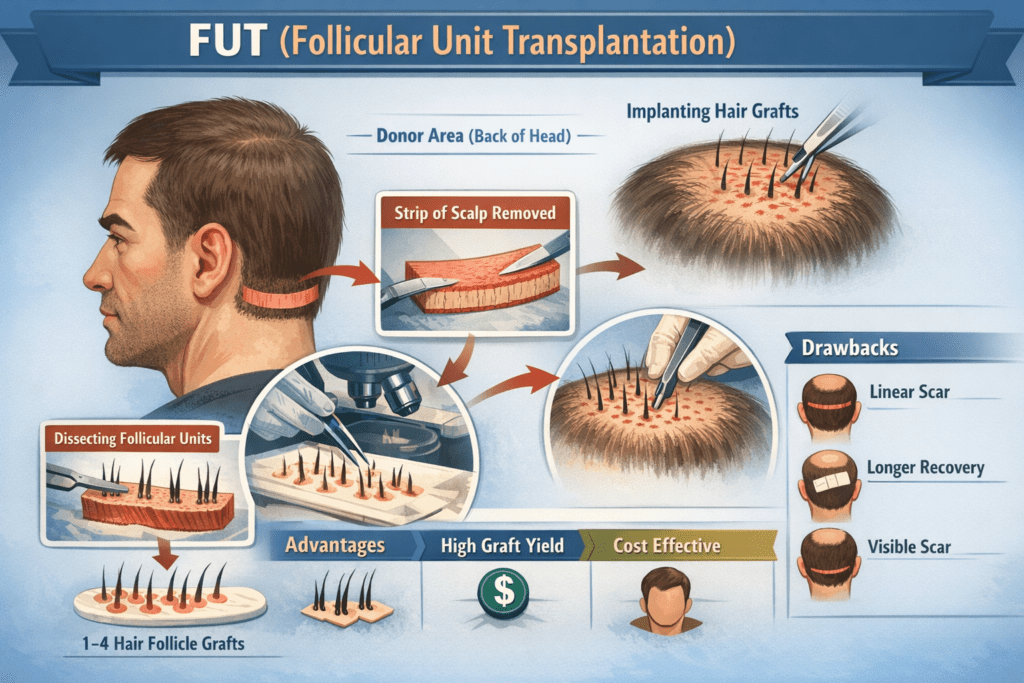
Commonly known as the “strip method,” FUT involves removing a narrow strip of scalp tissue from a donor area, typically in the back of the head, where hair growth is most stable. Under a microscope, the tissue is carefully dissected into individual follicular units containing one to four hairs. These grafts are then transplanted into areas of the scalp that are experiencing thinning and baldness.
Since the extracted follicles are handled with care under magnification, they remain well protected during preparation, which helps ensure excellent survival rates being transplanted.
FUT Advantages
- High graft yield per session: Ideal for patients needing to address extensive areas
- Cost-effective: Typically, less expensive per graft than FUE.
- Robust grafts: Tissue handling under the microscope protects follicles, improving survival.
FUT Drawbacks
- Linear scar: A thin line shaped scar remains in the donor area but is easily hidden by surrounding hair.
- Longer recovery: Mild tightness or tenderness at the donor site may occur for several days.
- Best for longer hairstyles: The linear scar is less noticeable when the hair is worn longer.
What Is FUE (Follicular Unit Extraction)?
Procedure Overview
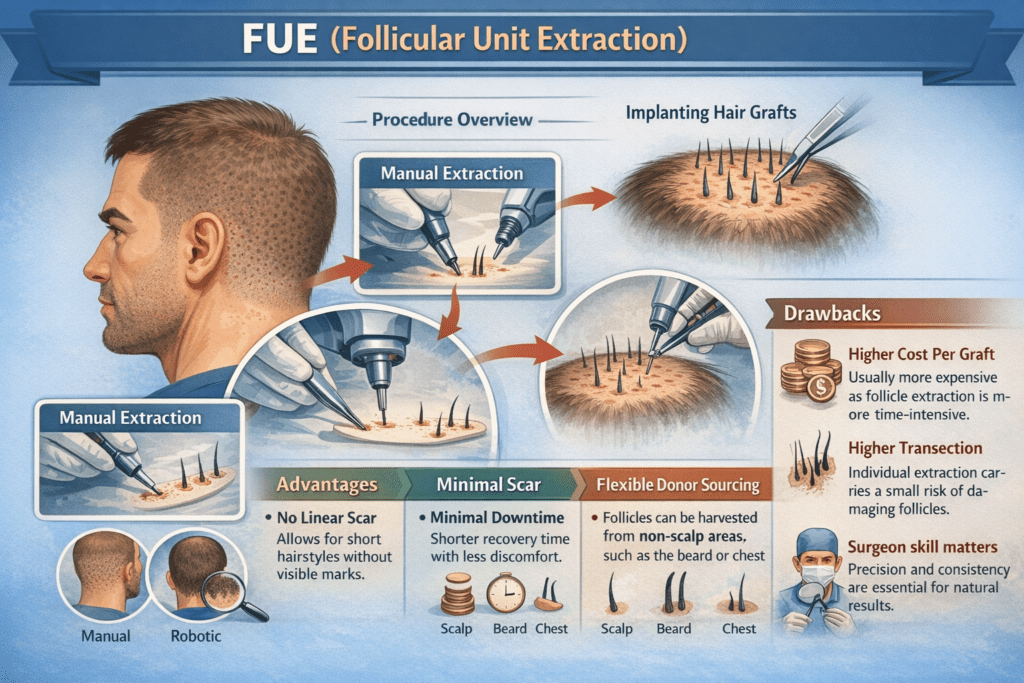
With FUE, individual hair follicles (or follicular units) are extracted one by one using a fine circular punch tool. The extraction process can be done either manually or by a robot. Each follicle is then individually implanted into the recipient site to create a natural pattern and density.
Instead of the linear scar that results with FUT, this minimally invasive technique leaves tiny dot-like scars and requires no sutures.
FUE Advantages
- No linear scar: Allows for short hairstyles without visible marks.
- Minimal downtime: Shorter recovery time with less discomfort.
- Flexible donor sourcing: Follicles can be harvested from non-scalp areas such as the beard or chest.
FUE Drawbacks
- Higher cost per graft: Usually more expensive as follicle extraction is more time-intensive.
- Slightly higher graft transection rate: Individual extraction carries a small risk of damaging follicles.
- Surgeon skill matters: Precision and consistency are essential for natural results.
| Category | FUT (Strip Method) | FUE (Follicular Unit Extraction) |
| Ideal Candidates | Large graft sessions | Minimal scarring or short hairstyles |
| Donor Area | Single linear section | Broad donor zone; can include beard/chest |
| Scarring | Linear scar | Tiny dot scars |
| Healing Time | 10–14 days | 5–7 days |
| Graft Survival | 95–98% | 90–95% |
| Procedure Time | 4–8 hours | 6–10 hours |
| Cost | Lower per graft | Higher per graft |
| Results | Dense, natural coverage | Natural, seamless blending |
| Best For | Extensive restoration | Minimal scarring and quick recovery |
FUT vs. FUE: Key Differences Explained
Results
Both approaches deliver natural, lasting results when performed by an experienced surgeon. FUT often achieves higher density in a single sitting, whereas FUE provides seamless blending with no visible scar line.
How Soon Results Appear
Both techniques are also similar in how the end results of the procedure develop:
- Initial shedding of transplanted hairs occurs over the first 2-4 months
- New hair growth begins around 3–4 months post-op
- Most patients experience noticeable density by 6–9 months after treatment
- Final results become visible at 12 months or longer
Ideal Candidates
FUT is best suited for patients who need a large number of grafts in one session (such as those with advanced hair loss) and who wear longer hairstyles to conceal a fine scar.
FUE works well for people seeking smaller touch-ups or who prefer short hairstyles and want to minimize visible scarring.
Donor Area
FUT removes a single strip of scalp, limiting the donor area to the back head where hair growth is permanent and dense.
FUE harvests individual follicles what can be taken from various donor areas including the side of the head, beard, or chest, offering more flexibility when donor hair is limited.
Scarring
FUT leaves a thin linear scar at the donor site, which can be visible if it is not covered up by longer hair.
In contrast, FUE creates tiny dot scars that are scattered and nearly invisible, even with very short haircuts.
Downtime (Recovery Time)
FUT requires a longer down time: typically, 10–14 days for the stitches to fully heal at the donor site.
Since FUE does not require a long incision and stitches, it has a shorter recovery time, around 5–7 days, with less discomfort.
Read our Hair Transplant Recovery Guide to learn more about the recovery experience.
Graft Survival
FUT grafts often achieve slightly higher survival rates (95–98%) since they are dissected under a microscope, ensuring that each follicular unit remains intact, hydrated, and well-protected by surrounding tissue. This minimizes trauma and typically results in follicles that a slightly more resilient.
FUE grafts are more delicate because each follicle is extracted individually. FUE grafts typically yield a 90–95% survival rate. While modern tools and robotic systems have improved consistency, some risk of partial transection remains.
Procedure Time
FUT sessions are often shorter than FUE sessions. Depending on graft count the average FUT sessions lasts somewhere between 4–8 hours.
FUE can take between 6–10 hours since each follicle is extracted individually. The additional time reflects the precision required for manual or robotic harvesting.
Procedure Cost
FUT is generally more cost-efficient per graft, making it ideal for addressing larger treatment areas.
FUE tends to cost more per graft due to the meticulous, time-intensive extraction process.
Which Technique Is The Best?
Selecting between FUT and FUE depends on several factors, including:
- Extent of hair loss and the size of the area to be restored
- Donor hair quality and density
- Desired hairstyle (long vs. short)
- Budget, recovery time, and personal preference
FUT is ideal for patients who require the highest graft yield and density, particularly those with advanced hair loss or extensive thinning. Because FUT harvests many grafts from a small donor area, it allows surgeons to cover large zones in a single session, which can reduce the total number of procedures needed. It is also a great option for patients who plan to wear their hair longer, since the fine linear scar is easily concealed. Those seeking maximum coverage, cost efficiency, and long-term graft preservation often find FUT to be the most practical choice.
FUE, on the other hand, is best suited for patients who prioritize minimal scarring, faster recovery, and flexibility in hair styling. The tiny dot scars left behind are nearly invisible, making this method ideal for individuals who prefer short hairstyles or frequently shave their head. FUE is also advantageous for smaller touch-up sessions, beard, or eyebrow restoration, or for patients who have previously undergone FUT and wish to optimize remaining donor areas. While it may be more time-intensive and costly per graft, many patients appreciate FUE’s quick healing, versatility, and cosmetic discretion.
Ultimately, the choice between FUT and FUE is highly individualized. A thorough consultation and scalp evaluation by an experienced hair restoration surgeon will help determine which method aligns best with your aesthetic goals, lifestyle, and long-term hair restoration plan.
Combining FUT and FUE
For some patients, the most effective hair restoration plan involves combining both Follicular Unit Transplantation and FUE Follicular Unit Extraction techniques. This hybrid or staged approach allows surgeons to take advantage of the strengths of each method. Typically, an FUT procedure is performed first to harvest a large quantity of grafts efficiently from the donor area. Later, FUE may be used to fine-tune the results: filling in smaller areas, blending the hairline, or increasing density in zones that need subtle refinement.
By using both techniques strategically, surgeons can maximize the available donor supply and achieve more comprehensive coverage, especially for patients with advanced hair loss or limited donor density. This approach is also valuable in revision cases, where prior transplant results need correction or enhancement. The combination of FUT and FUE offers greater flexibility, natural-looking results, and long-term sustainability of the donor area, helping patients reach their restoration goals with minimal compromise.

A united group of skin care specialists from Westlake Dermatology & Cosmetic Surgery, Austin's leader in Dermatology and Plastic Surgery. Articles posted under WD staff are authored through combined contributions from our entire team, including Plastic Surgeons, Dermatologists, Aestheticians, Physician Assistants, Aesthetic Nurses, and Patient Coordinators.
Disclaimer: The contents of the Westlake Dermatology website, including text, graphics, and images, are for informational purposes only and are not intended to substitute for direct medical advice from your physician or other qualified professional.