

A Plastic Surgeon’s Take on the Allogenic Fat Transfer (Renuva, AlloClae, DermaClae)

Volumizing treatments continue to evolve, and one of the newest trends gaining popularity on TikTok, Instagram, and aesthetic forums is allogenic fat transfer. Instead of using your own fat as in traditional fat grafting, these treatments use an off-the-shelf, donor-derived adipose matrix to restore volume, smooth contours, and rejuvenate areas such as the face, hands, and body. Popular brand names include Renuva, AlloClae, and DermaClae, each promoted as an injectable alternative to fillers and fat grafting.
Since these treatments involve biologic materials and rely on your body’s ability to regenerate fat, patients are understandably curious about how they work. Below, we take an in-depth look at the trend, including whether it works, who it is best for, and what to consider before trying it.
What Is the Allogenic Fat Transfer Trend?
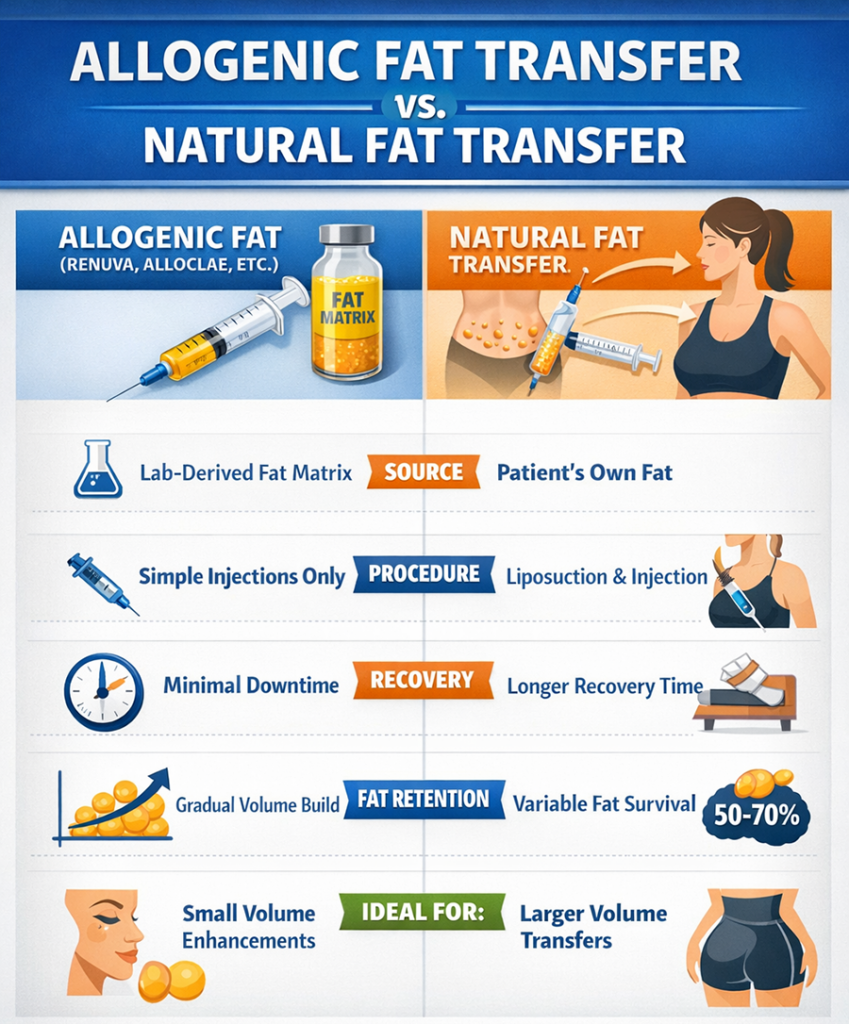
Allogenic fat transfer refers to injectable adipose matrix products that originate from screened donor fat. Unlike autologous fat grafting, which uses your own fat, these products provide a fat scaffold that allows your body to gradually regenerate its own tissue.
Common products include:
- Renuva, the most widely known option and an injectable allograft adipose matrix
- AlloClae and DermaClae, newer adipose matrix products positioned as alternatives to fillers and fat grafting
The trend grew online after influencers and aesthetic patients shared results showing natural-looking volume, smoother facial contours, and improvements in acne scars or hollows. These treatments are especially common on TikTok, Instagram Reels, and beauty trend discussions, often promoted as a natural filler alternative.
What Benefits Do Allogenic Fat Transfer Procedures Promise?
Marketing claims often highlight:
- A natural look and feel, since the body replaces the matrix with its own fat
- Long-lasting results, often one to two years or longer
- Improved texture and correction of contour irregularities
- A non-surgical option for areas that respond less well to synthetic fillers
- Better integration in delicate or mobile areas
Typical user claims online include:
- “It looks like my natural volume came back.”
- “My under-eyes look smoother without puffiness.”
- “This helped my acne scars more than filler.”
People are drawn to this trend because it appeals to individuals who want subtle, natural enhancement, and who prefer regenerative treatments over fillers. It is often positioned as a middle option between injectables and surgical fat transfer.
Does It Actually Work?
The science behind allogenic adipose matrices
Products like Renuva contain adipose extracellular matrix, collagen, structural proteins, and natural growth factors. When injected, the matrix acts as a supportive framework. Over time, your body remodels the area and generates new fat tissue through natural cellular processes.
Does this make sense cosmetically?
Yes, the concept fits both biologic and aesthetic principles. Fat is one of the most natural ways to restore youthful volume, and encouraging your own tissue to repopulate the area can create very natural results.
What does the evidence show?
- Clinical studies on Renuva show success in restoring volume, treating lipoatrophy, and improving contour irregularities.
- Results appear gradually over eight to twelve weeks, since the treatment relies on slow remodeling.
- Renuva has the strongest evidence because it has been available longer. Early findings for AlloClae and DermaClae are promising, but data is still emerging.
It is important to understand that outcomes vary based on anatomy, injector technique, and individual biology. Allogenic fat transfer cannot replace the dramatic results of surgical fat grafting and is not intended for areas that require sharp definition, such as the nose or chin.
Potential Risks or Downsides of Allogenic Fat Transfer
Although these treatments are considered safe overall, all biologic injectables carry potential risks. These include:
- Uneven volume if the product is placed incorrectly
- Overcorrection or undercorrection depending on how the tissue remodels
- Temporary firmness or swelling as the matrix integrates
- Nodules, especially if the product is injected too superficially
- Inflammatory or allergic reactions, although rare
- Unpredictable final volume, since each person remodels the matrix differently
Another downside is that results are not immediate, and patients must be willing to wait for gradual improvement. Treatment costs are often higher than traditional fillers because these products are biologic and specialized.
Are There Better Alternatives?
Allogenic fat transfer can be beneficial in the right circumstances. However, there are other great alternative treatment options with the ability to offer better outcomes. The ideal treatment depends on the amount of volume needed, the area being treated, and whether the patient prefers immediate or gradual results.
If you want instant volume:
- Hyaluronic acid fillers
Juvederm and other HA based fillers provide immediate results, are reversible, and come in multiple textures for different areas.
If you want a dramatic or long-lasting change:
- Autologous fat grafting
Surgical fat transfer is best for major volume restoration, and results can last many years, although it involves surgery and downtime.
If you prefer gradual, regenerative improvement:
- Biostimulatory injectables
Injectables like Sculptra or diluted Radiesse stimulate collagen and improve firmness. They do not create new fat, but they enhance structure and skin quality.
Some providers use combination approaches, such as biostimulators for structural support and adipose matrix injections for soft natural volume.
Who Should Try Allogenic Fat Transfer?
Good candidates include:
- Individuals who want natural, subtle enhancement
- Patients who do not want or cannot undergo surgical fat grafting
- Those who prefer volume without the puffiness that sometimes occurs with fillers
- People with mild hollows, early volume loss, or contour irregularities
It may be especially helpful for:
- Under-eye or cheek hollowing, especially post weight loss
- Temple concavity
- Mild cheek or jawline asymmetry
- Hand rejuvenation
- Acne scars or post-surgical contour issues
Not ideal for:
- Patients seeking dramatic or instant results
- Individuals with unstable autoimmune conditions
- People with sensitivities to biologic products
- Anyone expecting the same transformation as surgical fat transfer
A consultation with an experienced injector is essential because anatomy, medical history, and tissue quality determine which approach is most appropriate.
Final Thoughts
Allogenic fat transfer treatments, including Renuva, Alloclae, and DermaClae, offer a promising way to restore natural-looking volume without surgery. They work best for subtle, gradual enhancement rather than major reshaping. Allogenic fat transfer also does not have the added reshaping and recontour benefits provided by traditional fat transfer procedures.
In the right patient, and with a skilled injector, results can look exceptionally natural. However, they are not a universal substitute for fillers or surgical fat transfer, and realistic expectations are important.

Daniela Atencio, MD is a Board Certified Plastic Surgeon with fellowship training in cosmetic surgery. She learned from nationally renowned plastic surgeons and obtained extensive training in the entire spectrum of reconstructive and cosmetic plastic surgery. Dr. Atencio’s surgical interest is focused on face and breast aesthetics, as well as body-contouring surgery. She has extensive training and experience in both surgical and non-surgical modalities.
Disclaimer: The contents of the Westlake Dermatology website, including text, graphics, and images, are for informational purposes only and are not intended to substitute for direct medical advice from your physician or other qualified professional.