
From Graft to Growth: How Hair Transplants Work

Hair Transplant Science at a Glance
- Living follicles are strategically relocated from stable donor areas to balding or thinning areas.
- Transplanted follicles reestablish blood flow and restart the normal growth cycle.
- Natural results depend on surgical technique, graft survival, healing, and aftercare
Hair transplant surgery is the most effective treatment option for restoring natural hair in areas that experience moderate to severe balding. Unlike non-surgical options like prescription medications, hair transplants work by relocating living hair follicles that continue to grow hair in their new placement areas¹. Today’s hair transplant techniques are far more advanced than earlier iterations, current FUT and FUE techniques are rooted in decades of scientific understanding about hair follicle biology, graft survival, and tissue regeneration.
One of the most common questions from prospective patients involves the science of the procedure: How can hair follicles be removed from one area of the scalp and implanted somewhere else while remaining alive and capable of continued growth? The answer is found in the unique structure of the follicle and the biological processes that support its survival during transplantation.
Hair Follicles Are Living Organs
Each individual hair follicle is a complex living organ, with multiple structures responsible for growth, nourishment, and regeneration. The follicle has several critical components² work together to accomplish hair growth including:
- Dermal Papilla: a group of specialized cells that regulate growth
- The Hair Bulb: the area where hair shaft production begins and stem cells remain active
- The Sebaceous Gland: responsible for producing natural oils that protect hair and scalp
- Microvascular Network: which supplies oxygen and nutrients
As long as these components remain alive or intact, the follicle can continue functioning after being re-located to a new area on the scalp.
Donor Follicles Are Resistant to Hair Loss
Modern hair transplantation is based on the principle of donor dominance³. Hair follicles taken from the back and sides of the scalp are genetically resistant to DHT, the hormone responsible for patterned hair thinning. This is why hair in these regions continue to thrive while balding occurs along the hairline, crown, or mid-scalp areas.
Follicles in these areas are ideal for being transplanted since:
- Their growth remains stable throughout adulthood
- They are relatively dense and strong
- They have a resistance to thinning
Choosing grafts from this area helps ensure natural and lasting results.
The Science of Harvesting: How Follicles Are Removed Safely
Modern hair transplants use one of two techniques to harvest donor grafts. Each technique is proven to protect the graft and maintain its viability⁵.
Follicular Unit Extraction (FUE): Individual follicular units are removed using small circular punches that isolate each graft along with surrounding protective tissue.
Follicular Unit Transplantation (FUT): A thin strip of scalp is surgically removed (typically from the back of the head) and dissected under magnification, which allows technicians to separate each follicle while preserving its anatomical integrity.
In either method, the hair transplant surgeon and technicians focus on taking steps to minimize trauma, prevent transection, and preserve hydration to ensure the extracted grafts remain viable and can resume healthy growth when transplanted.
How Follicles Stay Alive Outside the Scalp
Like any form of organ transplant, the proper conditions allow hair follicles to remain alive and intact after being extracted. After removal, follicles temporarily enter a metabolic pause that allows them to survive for short periods outside the body. To maintain viability, the grafts are stored in chilled, sterile solutions that slow cellular activity and prevent drying.
There is a high correlation between shorter storage time and better graft survival. This is why experienced surgical teams work efficiently to minimize the time between extraction and implementation.
Implantation: How Follicles Establish in Their New Location
Creating Recipient Sites
While the extraction of donor grafts gets most of the attention, a key part of the hair transplant process involves the creation of recipient sites: targeted areas of the scalp that will receive the transplanted follicle. These recipient sites are carefully created using fine surgical instruments that control direction, angle, and depth. Recipient sites designed with both form and function in mind: ensuring that the transplanted grafts will thrive in their new environment and that new growth blends naturally with existing hair and follows realistic patterns⁶.
Revascularization
After implantation, follicles reconnect with the scalp’s blood supply through a process known as angiogenesis². The dermal papilla plays an important role in this survival phase as new vessels form and support early stabilization.
The First One to Two Weeks
During the initial healing period (post revascularization):
- Grafts become secured through fibrin binding
- Micro wounds close and surrounding skin recovers
- Follicles re-start the hair growth cycle, enter a resting stage before new growth begins
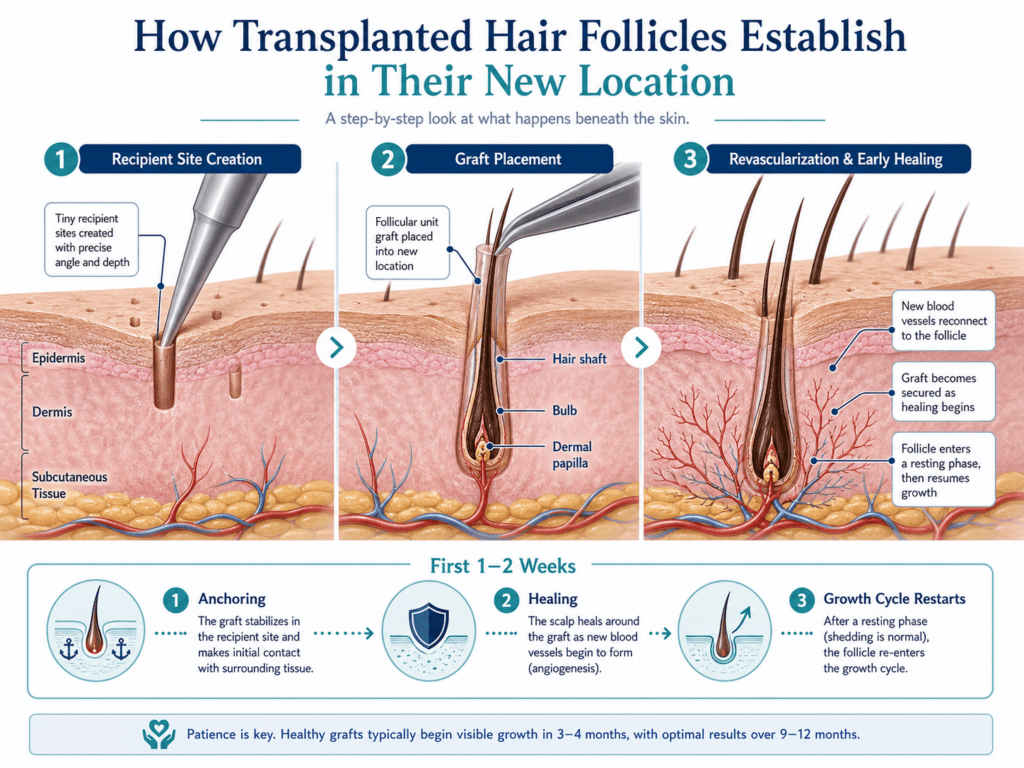
How Transplanted Grafts Continue Along The Hair Growth Cycle Once Implanted
Hair growth occurs through the hair growth cycle, a repeating process that makes follicles capable of withstanding temporary disruption when relocated⁴.
The growth cycle happens in three phases:
- Anagen phase: the active growth period
- Catagen phase: a short transitional or rest stage
- Telogen phase: the shedding and renewal period
Transplanted follicles are able to survive transplantation by entering the Catagen or resting stage⁵. This is a reaction that allows the follicle to survive any trauma experienced during extraction. Once blood flow is resumed, the follicle will naturally progress to the Telogen phase resulting in “Shock Loss” where shedding of existing hairs occurs. This is a completely normal part of the process, and the follicle will soon move on to the Angen phase where new hair growth can occur.
Factors That Influence Graft Survival and Results
Although hair transplantation has a high success rate, with typical graft survival rates between 90% to 98%. However, there are several factors that can influence how well the follicles heal, take root, and begin producing new hair. These factors fall into three distinct buckets: to the surgeon, the follicles themselves, and the patient’s own healing response.
Surgeon Skill and Technique
The experience and skill level of the surgeon (and surgical team) plays one of the most important roles in determining the overall success of the procedure (both the survival rate of grafts and the final appearance of the new hair growth).
Key elements include:
- Ensuring proper donor follicle extraction to maintain graft viability
- Recipient sites should be created by an experienced surgeon, (not technicians), who understands how an individual patient’s color contrast, hair caliber, hair characteristics, and density patterns will impact the outcome of the procedure.
- Using magnification and refining tools to protect delicate follicle structures during placement
- Optimizing the angle and direction of placement to ensure that new hairs grow in the same pattern as surrounding hair
- Creating natural hairline design, especially at the front of the scalp
Surgeons with extensive training in hair restoration are better equipped to ensure graft survival and create natural appearing results (by avoiding patterns that appear artificial or overly uniform).
Graft Handling
Donor follicles become more fragile as soon as they are removed from the scalp. The manner in which these follicles are handled in this critical time span (after extraction and before implantation) affects survival.
Important considerations include:
- Minimizing the time follicles stay outside the body (without a blood supply)
• Keeping grafts properly hydrated
• Avoiding rough handling (which can crush or damage the hair bulb)
• Maintaining proper temperature, since heat can reduce viability
Well-coordinated surgical teams work efficiently so grafts remain protected from dehydration and stress throughout the process.
Patient Factors
The patient’s overall health and lifestyle greatly effect how well grafts survive and thrive. Examples of issues that can negatively affect transplanted follicles include:
- Smoking cigarettes, which reduces blood circulation to the scalp and can slow healing
• The use of certain medications, especially those that increase bleeding or inflammation
• Scalp conditions, such as dermatitis or folliculitis, which may interfere with healing
• Patient age and their body’s unique healing response since some patients form stronger vascular connections than others
During consultation, providers review medical history to identify anything that may affect results and recommend steps to optimize healing beforehand.
Post Operative Care
Patients also play a major role in protecting newly implanted follicles in the first days and weeks after surgery. Properly protecting the grafts will ensure stronger graft anchoring and optimize healthy regrowth.
We always recommend following all aftercare instructions provided by your surgeon. Dr. Reese will review everything with you and likes to “keep things simple” during the early post-operative phase of your transplant. In most instances, patients can resume unlimited physical activity, (including shampooing and exercise), within 8 or 9 days of their procedure.
Conclusion
Hair transplantation works by relocating living, DHT resistant follicles that continue to grow naturally for life. Like the transplantation of other organs, hair follicles can survive extraction and implantation because of their unique anatomy, careful handling, and the body’s ability to restore circulation. With modern techniques and an experienced surgeon, patients can achieve natural looking, lasting results.
Sources
¹ Hair transplantation. (2025). Wikipedia. https://en.wikipedia.org/wiki/Hair_transplantation
² Hair follicle. (2025). Wikipedia. https://en.wikipedia.org/wiki/Hair_follicle
³ Androgenetic alopecia and donor dominance. (2025). International Society of Hair Restoration Surgery. https://ishrs.org
⁴ Hair growth cycle. (2025). Wikipedia. https://en.wikipedia.org/wiki/Hair
⁵ Follicular unit extraction and transplantation. (2025). Wikipedia. https://en.wikipedia.org/wiki/Follicular_unit_extraction
⁶ Hairline design and placement principles. (2025). International Society of Hair Restoration Surgery. https://ishrs.org

A united group of skin care specialists from Westlake Dermatology & Cosmetic Surgery, Austin's leader in Dermatology and Plastic Surgery. Articles posted under WD staff are authored through combined contributions from our entire team, including Plastic Surgeons, Dermatologists, Aestheticians, Physician Assistants, Aesthetic Nurses, and Patient Coordinators.
Disclaimer: The contents of the Westlake Dermatology website, including text, graphics, and images, are for informational purposes only and are not intended to substitute for direct medical advice from your physician or other qualified professional.
I can attest that communicating expectations is key if you are considering a hair transplant. Make sure to work with the surgeon on determining the new hairline, best advice I can give.