
Prescription vs. OTC Azelaic Acid: What Strength Do You Need?
Azelaic acid is one of the most versatile topical ingredients in skin care. It can help improve acne, calm visible redness, fade post-acne marks, and promote a clearer, more even-looking complexion, making it especially appealing for patients dealing with multiple concerns at once. It’s also considered a gentler active, making it ideal for individuals who have issues around sensitivity.
With both over-the-counter and prescription options now widely available, many patients are left wondering what the real difference is, and whether a stronger formula is actually worth it.
What Is Azelaic Acid?
Azelaic acid is a naturally occurring dicarboxylic acid that is also produced in the body and found in certain grains. In skin care, it is used as a topical ingredient to help improve acne, reduce inflammation, and fade some forms of discoloration. It has become popular because it is a versatile active ingredient that can fit into both acne-focused and redness-focused routines.
One reason azelaic acid stands out is that it is often considered a good option for patients who cannot tolerate harsher ingredients. While no active ingredient is completely irritation-free, azelaic acid is frequently viewed as a gentler choice for people with sensitive, reactive, or redness-prone skin. It is also commonly discussed as an option during pregnancy, although patients should still check with their own physician before starting any new treatment.
How Azelaic Acid Helps the Skin
Azelaic acid is a multitasking ingredient that can benefit the skin in several ways. Depending on the product and the patient’s concerns, it may help:
- Treat acne by reducing acne-causing bacteria and calming inflammation
- Keep pores clearer by helping open clogged pores
- Fade post-acne marks and improve lingering discoloration after breakouts heal
- Reduce visible redness, making it especially appealing for some patients with rosacea-prone skin
- Improve uneven skin tone and certain forms of hyperpigmentation
- Support smoother skin texture by encouraging gentle cellular turnover
- Address multiple concerns at once, including breakouts, redness, and discoloration
Azelaic acid can be especially useful for patients with rosacea-prone skin. Prescription azelaic acid 15% foam and gel are FDA-approved for the topical treatment of inflammatory papules and pustules of mild to moderate rosacea, and azelaic acid may also help reduce lingering color changes in some patients.
Although azelaic acid is not usually thought of as a stronger “peel-like” exfoliant such as glycolic acid, it can still help support clearer, smoother-looking skin over time. For many patients, that makes it a practical option when several skin concerns overlap.
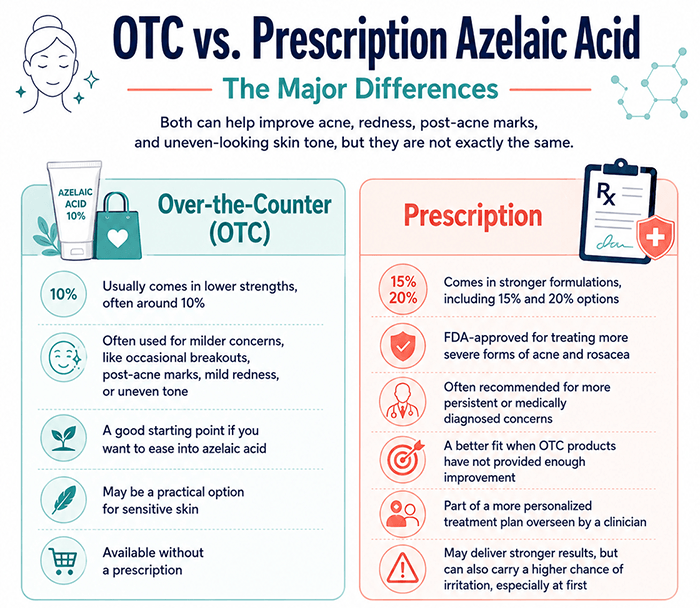
OTC vs. Prescription Azelaic Acid: The Major Differences
Although both over-the-counter and prescription azelaic acid can help improve the skin, there are a few important differences to keep in mind.
Over-the-counter azelaic acid
- Usually comes in lower strengths, often around 10%
- Often used for milder concerns, such as occasional breakouts, post-acne marks, mild redness, or uneven tone
- May be a good starting point for patients who want to ease into azelaic acid
- Can be a practical option for patients with sensitive skin who want a gentler active ingredient
- Is available without a prescription, making it easier to add to a skin care routine on your own
Prescription azelaic acid
- Comes in stronger formulations, including 15% and 20% options
- Is FDA approved for treating more severe forms of acne and rosacea
- Is often recommended for more persistent or medically diagnosed concerns
- May be a better fit when over-the-counter products have not provided enough improvement
- Is prescribed and overseen as part of a more personalized treatment plan based on the patient’s skin type and concerns
- May deliver stronger results, but can also carry a higher chance of irritation, especially when first starting
In general, over-the-counter azelaic acid may be a good fit for mild skin concerns or for patients who want to start slowly. Prescription azelaic acid is often the better option when acne, redness, or rosacea symptoms are more persistent or when a stronger, dermatologist-guided treatment plan is needed.
When To Increase Or Decrease Azeliac Acid Strength
Not everyone needs the strongest azelaic acid product available. In many cases, the right strength depends on how well your skin is tolerating treatment, how severe your concerns are, and whether you are seeing steady improvement over time.
Signs You May Be Ready for a Stronger Azelaic Acid
You may want to talk with your dermatologist about increasing strength if:
- you have been using a lower-strength product consistently and your skin tolerates it well
- you are seeing only minimal improvement in acne, redness, or discoloration
- your concerns are more persistent or moderate in severity
- you want a more targeted treatment plan for rosacea or inflammatory acne
Signs You May Need to Decrease Strength or Use It Less Often
A stronger product is not always better, especially if your skin is becoming irritated. You may need to decrease strength, reduce frequency, or simplify the rest of your routine if you notice:
- burning, stinging, or tingling that does not improve
- persistent dryness, peeling, or redness
- increased sensitivity to products you normally tolerate
- worsening irritation when azelaic acid is combined with other strong actives
How Each Should Be Used
Prescription azelaic acid should be used exactly as directed by the prescribing clinician and product labeling. FDA labeling for azelaic acid 15% foam and gel recommends applying a thin layer twice daily, typically in the morning and evening, after cleansing with a gentle cleanser.
Over-the-counter azelaic acid products do not all have the same directions, so patients should always follow the instructions on the packaging. In general, it is often smart to start slowly, especially if the patient already uses other active ingredients. The American Academy of Dermatology Association advises introducing one acne treatment at a time and giving it time to work, which is a useful rule for azelaic acid as well.
Whether the product is OTC or prescription, it is usually best to be cautious about layering too many potentially irritating actives at once. Ingredients like retinoids, benzoyl peroxide, glycolic acid, and salicylic acid can all be helpful, but combining several strong actives in the same routine may increase dryness, stinging, and irritation. In many cases, azelaic acid pairs best with a simple regimen built around a gentle cleanser, moisturizer, and daily sunscreen.
Who Benefits Most From OTC vs. Prescription Azelaic Acid?
Over-the-counter azelaic acid may be a good starting point for patients with mild acne, occasional clogged pores, post-acne marks, or early uneven tone who want a gentler active ingredient. It can also appeal to people whose skin does not tolerate more aggressive ingredients well and who want to test whether azelaic acid fits into their routine before considering prescription treatment.
Prescription azelaic acid may be more appropriate for patients with inflammatory acne, rosacea papules and pustules, more persistent redness-associated breakouts, or concerns that have not improved enough with OTC products. It can also be a better choice for patients who want a more structured plan from a dermatologist rather than trial-and-error with multiple skin care products.
Side Effects: OTC vs. Prescription Azelaic Acid
Azelaic acid is generally well tolerated, but both OTC and prescription products can cause irritation, especially when first introduced. Common side effects reported in either form include burning, stinging, tingling, itching, dryness, scaling, and mild redness or irritation.
In general, prescription-strength products may be more likely to trigger noticeable irritation simply because they are stronger and are often used to treat more active inflammatory conditions. That does not mean OTC products are irritation-free, though. The full formula matters too, including the base, other active ingredients, and how often the product is used.
Patients should cease using azelaic acid and check in with a dermatologist if burning, peeling, or redness becomes persistent, uncomfortable, or seems to be worsening rather than improving. Skin that feels raw, very dry, or inflamed may be a sign that the routine needs to be simplified.
Azelaic Acid vs. Similar Ingredients
Azelaic Acid vs. Retinol
Both azelaic acid and retinoids can help improve acne, clogged pores, and uneven tone. Retinoids are usually more associated with increasing cell turnover and treating comedonal acne, while azelaic acid may be the gentler choice for patients who also struggle with redness, post-acne marks, or sensitivity. Retinol is also considered a harsher active, compared to azelaic acid which is generally better tolerated.
Azelaic Acid vs. Salicylic Acid
Salicylic acid is best known for exfoliating inside the pore and helping clear oily, acne-prone skin. Azelaic acid can also help keep pores clear, but it may be the more versatile option for patients who want help with inflammation and lingering discoloration too.
Azelaic Acid vs. Glycolic Acid
Glycolic acid is an alpha hydroxy acid that is often used to exfoliate the skin’s surface, improve tone, and retexture dull skin. Azelaic acid is typically less “peel-like” and may be easier to tolerate, especially for patients who want to address acne, redness, and hyperpigmentation without pushing their skin too hard.
Azelaic Acid vs. Benzoyl Peroxide
Benzoyl peroxide is a classic acne ingredient used to reduce acne-causing bacteria and inflammatory breakouts. Azelaic acid can also help with acne, but it may be the better fit for patients who also want to target post-acne discoloration or who find benzoyl peroxide too drying.
Azelaic Acid vs. Niacinamide
Niacinamide is often used for barrier support, redness, and tone improvement, and it is commonly included in supportive skin care formulas. Azelaic acid is generally more treatment-oriented for acne, rosacea-related bumps, and discoloration, while niacinamide is often viewed as a gentler supporting ingredient.
Azelaic Acid vs. Vitamin C
Vitamin C is usually associated with antioxidant support and brightening. Azelaic acid can also help improve uneven tone, but it may be a more practical choice when acne, inflammation, or rosacea-prone skin are part of the picture too.
Azelaic Acid vs. Kojic Acid
Kojic acid is mainly known as a skin-brightening ingredient used to help reduce hyperpigmentation. Azelaic acid can also help with discoloration, but it has the added benefit of helping with acne and inflammation, making it a more multifunctional option for many patients.
Tips for Getting the Best Results With Azelaic Acid
To get the most out of azelaic acid, it helps to keep the rest of your routine simple and stay consistent. A few good rules to follow include:
- Consistent use is key as improvement often takes time
- Be patient with results, rather than switching products too quickly
- Stick to a simple routine with a gentle cleanser, non-irritating moisturizer, and daily sunscreen
- Wear sunscreen every day, especially if you are using azelaic acid to help improve post-acne marks or uneven skin tone
- Avoid layering too many strong actives at once which can increase dryness and irritation
- Pay attention to how your skin responds and adjust the rest of your routine if irritation develops
For many patients, azelaic acid works best when it is part of a balanced skin care regimen rather than combined with multiple aggressive treatments all at once.
The Bottom Line
Azelaic acid is one of the more versatile topical ingredients in skin care because it can help with acne, clogged pores, redness, and discoloration at the same time. Over-the-counter azelaic acid can be a good starting point for milder concerns, while prescription azelaic acid may be a better option for patients with rosacea, more persistent acne, or concerns that need a dermatologist-guided treatment plan.
If your skin is not improving with OTC products, or if redness, acne, or pigmentation issues seem more stubborn, it may be worth seeing a dermatologist. In many cases, the right formula, strength, and overall routine can make a big difference

Dr. Radhika Shah is a Board-Certified Dermatologist with expertise in medical, pediatric, surgical, and cosmetic dermatology, with a special focus on complex skin disease and its psychological impact. A native Texan, she completed her undergraduate, graduate, and medical training across respected Texas institutions, ultimately serving as Chief Resident during her dermatology residency at Baylor Scott & White. Dr. Shah is also an accomplished medical writer who has contributed textbook chapters and published research in leading dermatology journals. She is dedicated to delivering thorough, compassionate care and tailoring treatment plans to each patient’s unique needs. Dr. Shah is an active member of the American Academy of Dermatology and other professional societies.
Disclaimer: The contents of the Westlake Dermatology website, including text, graphics, and images, are for informational purposes only and are not intended to substitute for direct medical advice from your physician or other qualified professional.
This is a really useful topic for anyone dealing with acne, redness, or uneven skin tone. Choosing between prescription and OTC azelaic acid depends on your skin concerns and sensitivity level. Many people also combine skincare routines with microneedling Toronto treatments to improve skin texture and achieve more noticeable long-term results.