

Facial Balancing: Creating Face Harmonization With Dermal Fillers

Facial balancing takes a holistic approach to non-surgical facial rejuvenation. Instead of focusing on enhancing one feature at a time, balancing involves the evaluation of the face with a driving goal of restoring harmony between all facial proportions. Dermal fillers are placed strategically to enhance symmetry, refine contours, and create a naturally balanced appearance.
What Is a Facial Balancing Procedure?
Facial balancing is a customized injectable procedure focused on facial symmetry and alignment. Traditional filler treatments typically focus on a specific area, such as the lips or cheeks, without fully considering how that change affects the rest of the face.
Facial balancing takes a more comprehensive approach by evaluating all facial proportions and how each feature contributes to overall symmetry. By adjusting proportions and restoring structure where needed, balancing enhances natural beauty rather than altering it.
Various dermal fillers (like the Juvederm or Restylane filler lines) is placed strategically and conservatively to achieve balance. The goal is to create harmony across the entire face, which is why the approach is sometimes referred to as full-face rejuvenation or facial harmonization.
Since balancing is tailored to each individual patient, results are unique and designed to complement the individual’s own anatomy.
The Role of Proportion and the Golden Ratio (φ) In Balancing
Injectors often reference the golden ratio, which is number (approximately 1.618) that describes a pattern of proportions commonly found in nature. Many things that appear naturally balanced or pleasing to the eye follow this ratio, including seashells, flowers, and even certain facial structures.
In facial aesthetics, the golden ratio serves as a helpful reference point for how different features relate to one another. When the face follows proportions that are close to this ratio:
- The forehead, midface, and lower face appear visually balanced
- The width of the nose complements the width of the mouth
- The projection of the chin aligns well with the lips
- The cheekbones create a natural frame for the eyes
Injectors use these proportional relationships to determine where added structure or subtle volume may enhance overall harmony. For example, when the chin is recessed, the nose or cheeks may appear more prominent. By adding a small amount of filler to the chin, the entire face can look more proportional, even if no changes are made elsewhere.
It is important to remember that the golden ratio is not a rigid standard. Each patient has their own version of balance that reflects their unique facial structure, age, gender, and ethnic identity. Skilled injectors can use the golden ratio as a flexible guide to tailor a facial balancing treatment plan that supports the patient’s natural features.
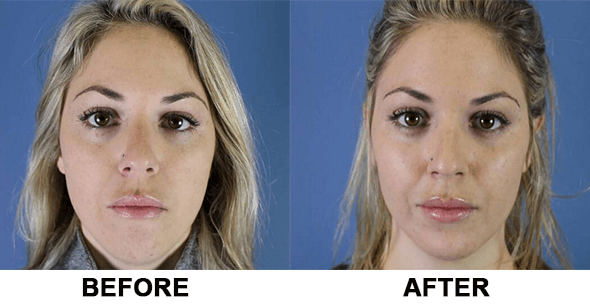
Before and after a facial balancing using Restylane Refyne and Restylane Defyne (4 syringes total; injected into the lower lip, chin, and cheeks).
How Facial Balancing Is Performed
Every facial balancing treatment begins with a thorough consultation and detailed facial analysis. This evaluation allows the injector to determine specific facial areas where subtle adjustments can enhance symmetry, projection, or contour.
Hyaluronic acid fillers are then used to add volume, define structure, or correct asymmetry. Common treatment areas include the cheeks, jawline, chin, temples, lips, nose, and tear troughs. No two patients receive the same approach because the placement and amount of filler depend entirely on the individual’s proportions and desired outcome.
Most patients complete their treatment in a single visit, while others may benefit from a staged approach where a succession of treatment sessions allows for added precision and refinement.
The Importance of Personalization
Each patient has their own version of balance. Expert injectors take time to understand a patient’s goals, cultural background, and unique aesthetic ideals. Successful facial balancing does not aim to create uniform features but instead enhances the individual’s natural proportions while respecting age, gender, and ethnic identity.
Who Is a Good Candidate for Facial Balancing?
Facial balancing is suitable for individuals who want a more proportional and harmonious appearance rather than dramatic or isolated changes. It is an excellent option for patients with:
- Mild to moderate facial asymmetries
- Volume loss from natural aging or weight loss
- Disproportion between features, such as a recessed chin, flat cheeks, or an undefined jawline
Both younger patients seeking contour enhancement and mature patients seeking rejuvenation can benefit. A consultation helps determine whether dermal fillers or another approach, such as surgical contouring or skin tightening, is the best treatment option for each patient’s desired end result.
Results: What to Expect
Facial balancing produces near instant results, with the added volume and structure being visible immediately after injection. Some degree of bruising or swelling is possible at injection sites, but both issues will subside in a few days following treatment. Within a week of treatment, patients often notice improved symmetry, smoother transitions between facial features, and a more harmonious overall look.
The goal of facial balancing is subtle enhancement; patients should expect balanced, refreshed results that do not appear overdone.
Video: Facial Balancing With Filler
How Long Do The Results Of Facial Balancing Last?
Filler treatments provide long-lasting results. While the duration of filler results varies from patient to patient (depending on factors like the type of filler used, facial area treated, and the patient’s unique metabolism), results typically last between 12 and 24 months. Structural areas such as the chin or jawline often retain filler longer than areas that experience frequent movements, such as the lips or cheeks.
Facial balancing results can be extended by undergoing periodic maintenance treatment sessions where filler is re-injected to “touch up” facial symmetry.
Recovery and Downtime
Most patients experience only mild and temporary side effects after facial balancing. Brusing, swelling, redness, or tenderness at injection sites may occur, but they typically subside 2-3 days after injection.
Normal daily activities can be resumed immediately following treatment, although makeup is best avoided for at least 24 hours. After your treatment, avoid wearing makeup for 24 hours. Most patients are also advised to avoid strenuous exercise, alcohol, heat exposure, and direct pressure on treated areas for the first 24 to 48 hours.
Patients should also avoid any dental procedures for at least 2 weeks after injections, as well as avoid all forms of vaccinations 2 weeks before and 2 weeks after treatment.
Facial Balancing Cost
Facial balancing pricing varies because the treatment is fully customized to each patient’s facial structure and aesthetic goals. In general, the cost of facial balancing typically ranges from $1,000 to $4,500, depending on the number of areas treated and the amount and type of dermal filler used. Some patients may achieve their desired results with a more conservative approach, while others may require additional filler or a staged treatment plan to gradually build balance and structure. A personalized consultation is the best way to determine exact pricing, as the final cost is based on your unique anatomy, degree of correction needed, and the results you want to achieve.
Why Choose an Experienced Injector
Facial balancing requires both medical expertise and artistic vision. Choose an experienced injector who specializes in utilizing multiple different fillers and understands facial anatomy at an advanced level. Experienced injectors evaluate the face comprehensively and make precise decisions about where to add structure, where to soften contours, and how to maintain natural symmetry.

Kelly Wala is a Registered Nurse with a Baccalaureate Degree of Science in Nursing from Eastern Kentucky University. As an Aesthetic Nurse Specialist for the past 10 years Kelly specialized in a full complement of non-surgical aesthetic services such as facial injectables, laser and light therapy, body contouring, and skin care. Kelly was the first in Texas to perform the Injectable Threadlift. Kelly is a Faculty trainer for Allergan Facial Aesthetics and Coolsculpting as well as a Faculty trainer for Galderma Facial Aesthetics and Sculptra. Aesthetics
Disclaimer: The contents of the Westlake Dermatology website, including text, graphics, and images, are for informational purposes only and are not intended to substitute for direct medical advice from your physician or other qualified professional.