
Does Liquid Microneedling Really Compare to Microneedling?

Liquid microneedling is rapidly gaining attention online, with influencers extolling its ability to smooth, brighten, and rejuvenate the skin. The appeal is easy to understand, a microneedling alternative that can be easily done at home, no device, needles, or in-office appointment needed.
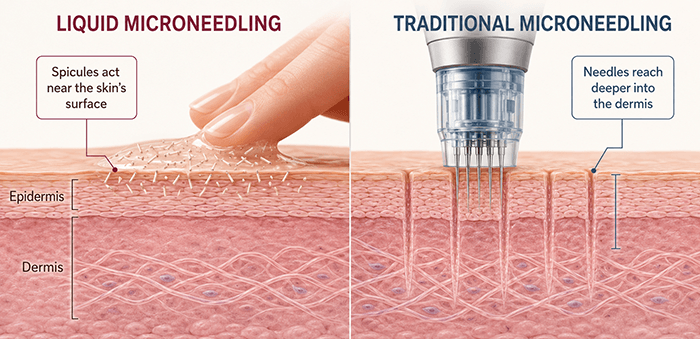
Despite its similar name, liquid microneedling is not nearly as effective as traditional microneedling. Liquid microneedling is really just a new exfoliation option that is confined to surface-level improvements. Traditional microneedling creates controlled damage that stimulates collagen production deep in the skin, leading to long-lasting results.
If you are considering giving liquid microneedling a try, here’s what you should know:
What Is Liquid Microneedling?
Liquid microneedling is a term that refers to non-prescription strength spicule-based skin care products that can be applied at home. While formulations can vary, the main ingredient in any liquid microneedling product are spicules, which are microscopic, needle-like particles often derived from marine sponges or similar materials. These spicules are applied topically and massaged into the skin, where they exfoliate the outer layers of the skin and create a tingling or prickly sensation.
While liquid microneedling may help with mild exfoliation, temporary glow, or enhanced product absorption, it does not provide the same under-skin improvement or collagen-stimulating power as professional microneedling
What Is Traditional Microneedling?
Traditional microneedling is an in-office skin rejuvenation procedure performed with a specialized device. The device uses ultra-fine needles to create controlled microchannels in the skin, triggering the skin’s natural healing response while encouraging new production of skin firming collagen and elastin.
Traditional microneedling may be used to improve:
- acne scars
- fine lines and wrinkles
- uneven skin texture
- enlarged pores
- stretch marks
- surgical scars
- mild crepiness
- overall skin quality
Liquid Microneedling vs. Traditional Microneedling: Key Differences
| Category | Traditional Microneedling | Liquid Microneedling |
| Method | Sterile needles create controlled micro-injuries | Spicule particles create prickly, surface-level exfoliation |
| Depth | Adjustable and controlled by provider | Surface level only |
| Strength | More powerful collagen-stimulating procedure | Typically, milder and less consistent |
| Oversight | Performed by a trained professional | Used at home (DIY) |
| Best for | Acne scars, wrinkles, scars, stretch marks, texture | Temporary glow, smoother feel, mild exfoliation |
| Results | More predictable when performed correctly | More variable and usually less dramatic |
| Main concern | Requires proper technique and aftercare | Can irritate skin and is often used without supervision |
Traditional Microneedling Is More Powerful
Liquid microneedling only addresses the top layers of skin, very similar to other physical exfoliation models. While this can result in some improvement, liquid microneedling will not penetrate the skin and created the same level of controlled damage needed to produce the same degree of collagen remodeling (and thus results).
For cosmetic concerns like acne scars, stretch marks, fine lines, wrinkles or moderate to severe texture concerns, liquid microneedling is just not strong enough to deliver long-term improvement.
Traditional Microneedling Is More Customizable
Traditional microneedling is highly customizable. A skilled provider can adjust the treatment based on the patient’s skin type, the area being treated, the skin’s baseline condition, the depth of the concern, the patient’s healing history, and the desired result. his is especially important for patients with acne scars, stretch marks, surgical scars, sensitive skin, melasma, rosacea, darker skin tones, or a history of pigmentation issues.
Liquid microneedling involves the use of a one-size-fits-all product. Both the product formulation and its application are not tailored to the needs of each individual patient.
Traditional Microneedling Results Are More Predictable
Professional microneedling typically produces more predictable results because the treatment can be carefully controlled and customized by a trained professional
With liquid microneedling, results vary as factors like spicule concentration, application technique, frequency of use can differ greatly. One patient may tolerate a spicule product well and notice improvements, while another may experience redness, peeling, stinging, or irritation.
Who Should Avoid Liquid Microneedling
Liquid microneedling may not be appropriate for all individuals. Users should be especially cautious if they have:
- sensitive or reactive skin
- rosacea
- eczema or dermatitis
- active acne or folliculitis
- a damaged skin barrier
- recent sunburn
- melasma or pigment-prone skin
- a history of keloids or abnormal scarring
- active cold sores or a history of herpes outbreaks
- recently used strong actives like retinoids or exfoliating acids
Since liquid microneedling is sold as a serum, mask, or topical treatment, many people automatically assume it is low-risk. But “topical” does not always mean gentle.
Possible unwanted effects of liquid microneedling may include burning, stinging, redness, dryness, peeling, itching, increased sensitivity, barrier disruption, worsening inflammation, and pigment changes in irritation-prone patients. As always, it may be wise to discuss liquid microneedling with your dermatologist before adding it to your regimen.
The Bottom Line
Despite the marketing hype liquid microneedling and traditional microneedling are not the same!
While liquid microneedling (spicule-based products) may offer mild smoothing, exfoliation, or temporary radiance for some patients, they do not provide the same precision, depth control, collagen stimulation, or predictability as professional microneedling. Liquid microneedling is also more variable and is often used without professional guidance, which can increase the risk of irritation, barrier damage, or unwanted side effects.
Traditional microneedling is still the better option when the goal is meaningful improvement in skin texture, scars, stretch marks, fine lines, or collagen stimulation.

Madison Balcome is a Licensed Aesthetician in Austin ,Texas. Madison specializes in laser treatments including Laser Hair Removal, Fraxel, and Vbeam, with extensive training in various skincare treatments including chemical peels, facials, microneedling, dermaplaning, microdermabrasion, and CoolSculpting. Through her genuine passion for product knowledge and her dedication to empowering others with the tools and information they need to care for their skin, Madison inspires countless individuals to embrace skin care as a journey of self-care and confidence-building.
Disclaimer: The contents of the Westlake Dermatology website, including text, graphics, and images, are for informational purposes only and are not intended to substitute for direct medical advice from your physician or other qualified professional.