

Preservé™ (Preservation Breast Augmentation): A More Natural Approach to Breast Enhancement
Breast augmentation continues to evolve. Today’s patients are seeking more natural looking and feeling results while requesting options that minimize invasiveness. Preservé™, a form of preservation breast augmentation, is a newer surgical technique designed to enhance breast shape and volume while prioritizing preservation of natural breast tissue, nerves, and blood supply.
Unlike traditional breast augmentation, which typically requires significant tissue manipulation for implant placement, Preservé focuses on working with the patient’s existing anatomy. This approach appeals to patients who want subtle, more refined breast enhancement with less downtime.
What Is Preservé (Preservation Breast Augmentation)?
Preservé is a minimally invasive breast augmentation technique that emphasizes tissue preservation. The goal is to enhance breast shape and fullness while maintaining the integrity of natural breast structures, including nerves, ligaments, and blood vessels.
The technique utilizes a lower level of sedation, places the implant in front of the muscle, and uses specialized surgical tools designed to gently separate tissue rather than cut or cauterize it. Motiva implants are used which are typically smaller in size and are placed in the upper inner quadrant of the breast to recruit the rest of the breast tissue up and in. Preservé is suitable for many breast sizes and can even be used in combination with breast lifting techniques.
By preserving natural breast anatomy, Preservé provide many benefits including natural movement, sensation, and healing following surgery (Motiva USA).
Why Preservation Matters in Breast Augmentation
The breast is composed of glandular tissue, fat, connective tissue, nerves, and a complex blood supply. Traditional breast augmentation techniques often involve cutting, cauterizing, or stretching these structures to create a pocket for implant placement.
Preservation breast augmentation seeks to protect these vital components whenever possible. Preserving nerve pathways may help support breast and nipple sensation. Maintaining blood supply plays an important role in healing and long-term tissue health. Minimizing trauma to natural breast tissue may also contribute to a more natural feel and appearance after surgery.
Preservé is designed around the principle that how breast tissue is handled during surgery can influence both recovery and long-term outcomes.
What Are the Benefits of Preservé?
Preservé (and preservation augmentation in general) provides many benefits including:
- Less anesthesia related side effects as it requires a lower level of sedation
- Lower chances of visual scarring as the technique uses smaller incisions compared to traditional breast augmentation
- Natural breast tissue functionality and appearance is preserved
- Implant placement in front of the chest muscle, avoiding muscle disruption
- Reduces risk of sensation changes as breast nerves and blood vessels are preserved
- No use of cautery, which reduces heat related tissue trauma
- Typically, less downtime (shorter recovery)
- Natural looking and feeling results
How Is a Preservation Breast Augmentation Performed?
Preservé is performed using specialized instrumentation designed to minimize tissue disruption. All surgeons credentialed to provide Preservé must complete hands-on surgical training in order to order and use the devices.
Since the surgery is less invasive, Preservé can often be performed using twilight and local anesthesia rather than general anesthesia. The procedure starts with the creation of small incisions (less that 2.5cm in length) along the breast crease. Rather than cutting or cauterizing tissue, surgeons use careful blunt dissection techniques to create space for the implant.
Next, Motiva implants are placed above the muscle. The technique typically uses smaller sized implants that are placed in the upper inner quadrant of the breast. This strategic placement allows existing breast tissue to be recruited upward and inward, enhancing shape while maintaining a natural appearance.
Throughout the procedure, careful attention is given to preserving nerves, blood supply, and natural breast architecture.
How Does Preservé Compare to Traditional Breast Augmentation?
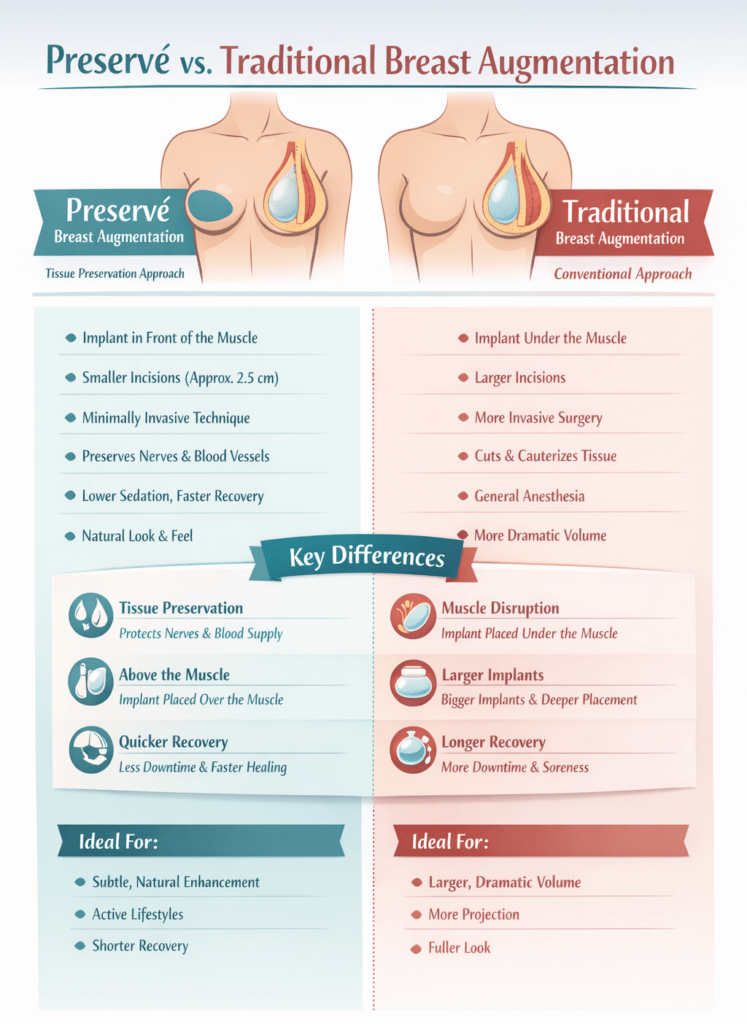
Preservé differs from traditional breast augmentation as it prioritizes tissue preservation, typically uses smaller sized implants, and places the implant above the muscle. The approach often results in less muscle related discomfort after surgery.
In contrast, traditional breast augmentation may involve placing implants under the muscle, utilize larger sized implants, and requires more extensive surgical pockets for implant placement.
It is important for patients to understand that traditional breast augmentation techniques remain effective and appropriate for many patients. In fact, traditional techniques may be a better fit for some patients depending on their anatomy and desired outcome.
Who Is an Ideal Candidate for Preservé?
Preservé may be well suited for patients who are in overall good health, seek more subtle breast enhancement (i.e. ballerina breast augmentation), want to minimize scarring, and who want a quicker and easier recovery.
Specifically, it is a great option for women who:
- Desire subtle to moderate breast enhancement (an increase of 1 to 2 cup sizes). Often deemed ballerina breast augmentation
- Prioritize a natural look and feel over dramatic results
- Have adequate existing breast tissue
- Live a more active lifestyle
- Prefer above-the-muscle implant placement
- Are interested in a potentially shorter recovery period
Like any surgical procedure, an in-person consultation with a board-certified plastic surgeon is essential to determine candidacy.
Can Preservé Be Combined With a Breast Lift?
In some patients, Preservé can be combined with breast lifting (mastopexy) techniques to address both breast volume and position. This approach may be appropriate for patients experiencing mild to moderate breast sagging who also desire subtle enhancement.
Careful evaluation and surgical planning are required to determine whether a combined procedure is appropriate.
What Is Recovery Like After Preservé?
Breast augmentation recovery following Preservé is often reported as easier, shorter, and more comfortable compared to traditional breast augmentation recovery. The use of smaller implants, above muscle placement, and less invasive incisions mean that most Preservé patients experience less discomfort and swelling post-procedure.
Since the chest muscle is not disturbed with Preservé, many patients experience less upper body tightness or soreness and are able to report to work and light physical activity in 1-2 days following surgery (compared to 3-5 days in many cases of traditional breast augmentation).
Most patients will be able to return to moderate exercise 2 weeks post-op. Within 6 weeks, many patients will be cleared for high impact exercise including weight lifting, swimming, and sports. While implant settling is far less compared to traditional augmentation, the full results of Preservé can take up to 12 months to manifest.
As with any surgical procedure, following all post-operative care instructions provided by your surgeon is essential for optimal healing and achieving long-term results.
Limitations of Preservé
While Preservé offers many advantages, it is not ideal for every patient. The primary limitation of Preservé is that it provides more modest enhancement. Thus, it is not an effective treatment option for women who seek a large increase in breast volume or who want a more dramatic result.
Other limitations include:
- May not fully correct significant breast asymmetry on its own
- Requires adequate existing breast tissue
- May not be appropriate for all breast shapes or anatomy
- Less customization in terms of restricted implant size, profile, and placement options
- Preservé is a newer technique with less clinical support/documentation
As with all breast implant procedures, patients should also understand general surgical risks, including capsular contracture, implant displacement, changes in sensation, or the need for future revision surgery (Plastic Surgery Hub).
Cost Considerations and Surgeon Training
Preservé breast augmentation is typically more expansive than traditional breast augmentation since it is a highly specialized technique that relies on advanced technology and surgeon expertise. The procedure uses Motiva implants along with specialized surgical instrumentation designed to preserve natural breast tissue. Surgeons who provide Preservé must complete mandatory, hands-on training to be authorized to perform Preservé and access the required devices. These added requirements reflect the precision, training, and innovation involved in delivering this advanced approach to breast augmentation.
Is Preservé Right for You?
Preservé offers a refined approach to breast augmentation for patients who value tissue preservation, natural results, and thoughtful surgical planning.
A consultation with a board-certified plastic surgeon allows patients to determine whether Preservé aligns with their anatomy, goals, and expectations. The most successful outcomes are achieved through individualized treatment planning guided by experience and expertise.
Works Cited
Motiva USA. Preservé®: A less invasive breast enhancement technique designed to preserve natural anatomy. Motiva Implant Matrix. https://motiva.health/patients-preserve/
Plastic Surgery Hub. What is Preservé? Motiva’s preservation breast augmentation explained. Overview of risks, benefits, and limitations of preservation techniques. https://www.plasticsurgeryhub.com/blogs/what-is-preserve-motivas-breast-implant/

Cameron Craven MD, FACS is board certified by the American Board of Plastic Surgery. Dr. Craven specializes in the full spectrum of cosmetic surgery including breast augmentation, liposuction and body contouring, facial rejuvenation, laser surgery, eyelid surgery, and rhinoplasty, as well as reconstructive surgery for skin cancers.
Disclaimer: The contents of the Westlake Dermatology website, including text, graphics, and images, are for informational purposes only and are not intended to substitute for direct medical advice from your physician or other qualified professional.