
Regenerative Therapies Compared: PRP vs. PDGF vs. PDRN

Most patients are familiar with injectable treatments like dermal fillers and Botox. These treatments are highly effective and remain the gold standard in non-surgical rejuvenation. However, a newer category of treatments is increasingly being discussed: regenerative therapies.
Unlike fillers (which add volume) or neuromodulators (which relax muscles), regenerative treatments stimulate the skin’s own repair pathways. Rather than placing structure into the skin, they improve tissue quality at a cellular level.
Three of the most talked about regenerative options today are PRP, PDGF, and PDRN. While they share a common goal of improving collagen production and overall skin health, they are not interchangeable. Each works differently, is sourced differently, and may be better suited for certain concerns. This post will provide a closer look at the benefits and differences of each.
What Are Growth Factor and Regenerative Therapies?
Regenerative aesthetics focuses on restoring skin function. These treatments enhance cell signaling, which is how skin cells communicate and coordinate repair.
Growth factors and molecular messengers instruct fibroblasts to produce collagen and elastin, stimulate blood vessel formation, and strengthen tissue architecture. By amplifying these natural signals, regenerative therapies can gradually improve firmness, texture, and resilience.
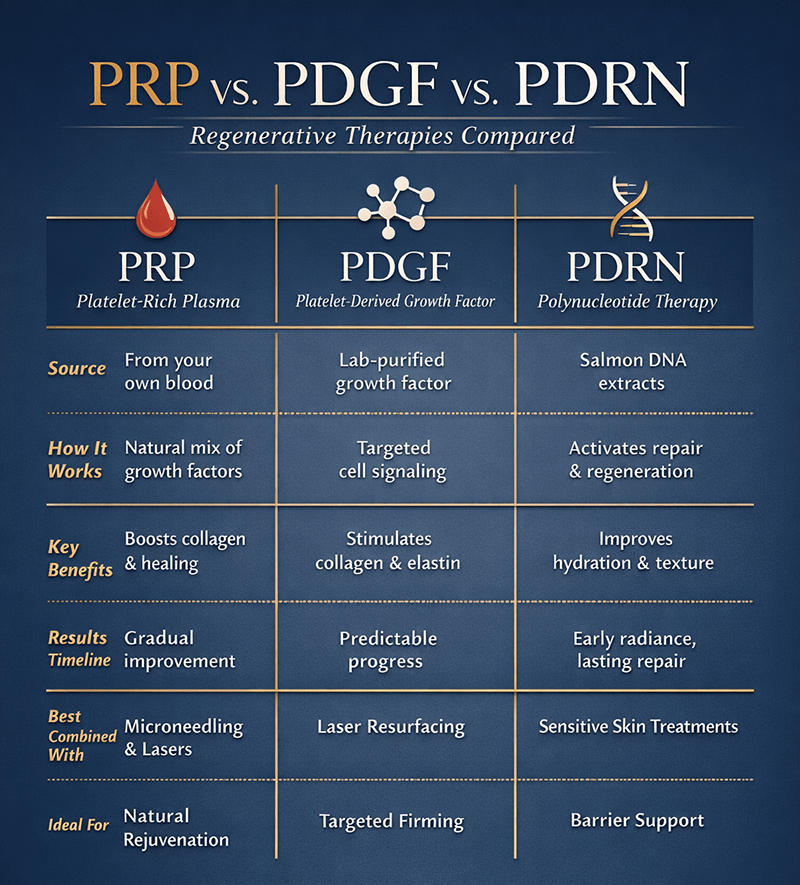
Here is a simplified overview:
- PRP uses growth factors derived from your own blood
- PDGF delivers a specific, purified growth factor in a controlled concentration
- PDRN uses polynucleotide fragments to activate regenerative pathways
On surface, these treatments may seem very similar. They are each “skin boosters” that can be used alone or in combination with other in-office treatments like microneedling or laser resurfacing. However, each differs greatly in many factors including how they work and the benefits they provide.
PRP (Platelet-Rich Plasma)
What Is PRP?
PRP is a concentrated solution of platelets obtained from the patient’s own blood. Platelets naturally contain multiple growth factors involved in wound healing and tissue repair.
How Does PRP Work?
Once injected or applied during microneedling, PRP releases growth factors such as PDGF, VEGF, and TGF-beta. These signals:
- Stimulate fibroblasts
- Increase collagen and elastin production
- Enhance wound healing pathways
- Improve skin thickness and texture
Because PRP contains a broad mix of growth factors, its regenerative signaling is wide-ranging.
How Soon Will Results Appear
Improvements are gradual. Patients typically begin noticing smoother texture and improved tone within several weeks, with continued collagen remodeling over two to three months.
How Long Results Last
Collagen stimulation from PRP can last several months. A series of treatments is often recommended, followed by periodic maintenance.
Level of Scientific Evidence
PRP has extensive research supporting its use in wound healing, orthopedics, and hair restoration. Its aesthetic applications continue to expand with growing clinical support.
Degree of Variability
Because PRP is derived from your own blood, concentration and response can vary between patients. Individual biology plays a role in outcomes.
Best Combined With
PRP is frequently paired with:
- Microneedling
- Laser resurfacing
- Hair restoration procedures
Ideal Candidates
- People who desire natural alternative
- Patients comfortable with a blood draw
- Those who seek to correct mild to moderate signs of aging
PDGF (Platelet-Derived Growth Factor)
What Is PDGF?
PDGF is a specific, purified growth factor delivered in a controlled concentration. Unlike PRP, which provides multiple signals, PDGF focuses on targeted fibroblast stimulation. By promoting the proliferation of fibroblasts and endothelial cells, PDGF plays a key role in the production of collagen and elastin, two essential components for maintaining youthful, healthy skin.
How Does PDGF Work?
PDGF, like PRP, supports the skin’s natural repair process. Once applied, it attaches to specific receptors on skin cells and activates a series of regenerative signals.
These signals help:
- Stimulate fibroblasts to produce more collagen and elastin, improving firmness and elasticity
- Encourage the formation of new blood vessels, which enhances circulation and nutrient delivery
- Promote the growth of new skin cells to support repair
- Strengthen and remodel the skin’s underlying structure
How Soon Will Results Appear
Results develop gradually over several weeks. Many patients appreciate the predictable nature of the response when used within structured treatment protocols.
How Long Do Results Last
Longevity depends on the overall treatment plan and whether it is combined with resurfacing procedures. When used strategically, collagen remodeling can be long lasting.
Level of Scientific Evidence
Ariessence Pure PDGF+ is a recombinant PDGF and is the only growth factor with four FDA-approvals. It has been utilized therapeutically for various treatments including orthopedic and maxillofacial surgery applications in over five million patients over the past 15 years.
Degree of Variability
As a lab-engineered product manufactured under controlled conditions, PDGF offers standardized dosing and minimal variability.
Best Combined With
PDGF is often paired with:
- Fractional laser resurfacing
- Chemical peels
Ideal Candidates
- Patients seeking predictable outcomes
- Individuals who prefer to avoid a blood draw
- Those pursuing more targeted collagen stimulation
PDRN (Polynucleotides or “Salmon DNA” Therapy)
What Is PDRN?
PDRN (often called a salmon sperm facial, polynucleotide therapy, or salmon DNA) consists of highly purified polynucleotide fragments derived from salmon DNA. These fragments are biocompatible and structurally similar to human DNA.
How Does PDRN Work?
PDRN activates adenosine A2A receptors, which helps:
- Stimulate tissue regeneration
- Enhance angiogenesis through VEGF
- Improve dermal thickness
- Strengthen barrier function
Rather than delivering growth factors directly, PDRN encourages the skin to upregulate its own regenerative mechanisms.
How Soon Will Results Appear
Many patients notice improvements in hydration, smoothness, and radiance relatively early. Structural changes, such as improved dermal thickness, develop gradually.
How Long Do Results Last
PDRN is commonly performed in a series to build cumulative improvement in skin quality. Maintenance sessions may be recommended depending on goals.
Level of Scientific Evidence
PDRN is a newer treatment but it does have a growing body of research, particularly in Europe and Asia, that shows its efficacy in healing and tissue repair. Its use in aesthetic medicine continues to expand.
Degree of Variability
Because PDRN is manufactured and purified under controlled conditions, outcomes are generally consistent across treatments.
Best Combined With
PDRN is frequently paired with:
- Laser treatments
- Post-procedure recovery
Ideal Candidates
- Sensitive or inflammation-prone skin
- Barrier compromise
- Early laxity or crepiness
- Patients seeking improved overall skin quality
How Do Regenerative Therapies Differ From Injectables?
It is important to understand that regenerative therapies serve a different purpose than fillers or neuromodulators (Botox):
- Fillers restore volume and structural support.
- Botox and other neuromodulators relax muscle movement to soften dynamic wrinkles.
- Regenerative therapies improve long-term tissue quality and collagen production.
Often, all three approaches are complimentary. For example, a patient may use Botox to address expression lines, filler to restore lost volume in targeted areas, and regenerative therapy to enhance overall skin thickness and resilience.
Regenerative Therapies After In-Office Treatments
Regenerative therapies are often paired with numerous in-office procedures that create controlled skin stimulation, including:
- PRP combined with microneedling
- PDGF following resurfacing procedures
- PDRN after laser treatments
When delivered during the skin’s active repair window, regenerative therapies work to amplify collagen formation and optimize healing.
Which Regenerative Therapy Is Right for You?
There is no universal “best” option, as each therapy has distinct advantages. The right fit often depends on several patient-specific factors including their unique skin characteristics, how much structural support is needed, and whether the primary underlying concern involves collagen stimulation, barrier repair, or overall skin quality.
Some factors that should be considered include the patient’s:
- Skin quality and degree of laxity
- Sensitivity or inflammation tendencies
- Comfort with a blood draw
- Desired results
The best way to determine which regenerative therapy is best for you is to visit an experienced provider for an in-person assessment. An in-office consultation will allow the provider to assess skin thickness, elasticity, healing response, and overall facial anatomy. A customized treatment plan can then be developed to achieve your desired final result.
The Future of Aesthetic Medicine
Regenerative therapies represent an evolution in aesthetics. They are not about freezing movement or directly filling volume. Instead, they focus on the long-term restoring of proper skin function, improving collagen architecture, and supporting healthier skin over time.
If you are interested in PRP, PDGF, or PDRN, a consultation with an experienced provider is the best way to determine the most appropriate plan for your skin and long-term goals.

Dr. Kellie Reed specializes in aesthetic skin care, general medical dermatology, pediatric, and rheumatologic dermatology. She is passionate about her patient care and attention to detail, and her positive attitude provides a sense of comfort for her patients. Dr. Reed is a member of the Travis County Medical Society, Texas Medical Association, Texas Dermatological Society, Austin Dermatological Society, Women’s Dermatologic Society, Rheumatologic Dermatology Society, and the American Academy of Dermatology.
Disclaimer: The contents of the Westlake Dermatology website, including text, graphics, and images, are for informational purposes only and are not intended to substitute for direct medical advice from your physician or other qualified professional.