
Melanotan II (“Tan Jabs”): Why They’re Not Worth The Risk
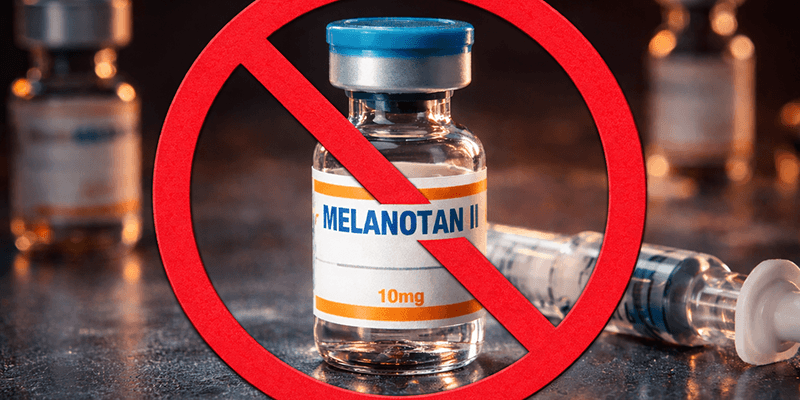
“Tanning injections,” often referred to as Melanotan II (MT-II) or “tan jabs,” are gaining attention on social media as a shortcut to achieving a darker skin tone without prolonged sun exposure.
Recent posts have touted tan jabs as a convenient way to tan faster, reduce sunburn risk, and achieve a more even complexion.
To be clear, Melanotan II:
- Is not currently approved by the FDA
- Cannot be legally marketed or sold as a drug, supplement, or cosmetic product
- Is not used in standard medical practice
- Is largely unregulated, with no reliable assurance of purity, sterility, or dosing.
Despite these concerns, some individuals continue to buy and use these products online.
In this post, we’ll discuss Melanotan II (and other tan jabs), how they work, and the risks they entail. More importantly, you will learn why it’s best to avoid Melanotan II and how to achieve a tanned look more safely.
What Is Melanotan II?
Melanotan II is a synthetic peptide originally developed in research settings to study its effects on pigmentation and appetite regulation.
It is designed to mimic melanocyte-stimulating hormone (MSH), a natural hormone that influences melanin production in the skin. Increased melanin can lead to darker pigmentation.
Melanotan II is typically marketed online as:
- Injectable “tan jabs”
- Nasal sprays
- Unregulated peptide products
Melanotan II is not FDA-approved for tanning or cosmetic use, and products sold online often vary in purity, dosing, and safety.
How Melanotan II Works?
Melanotan II binds to melanocortin receptors in the body, which can stimulate melanin production in the skin.
In theory, this may result in:
- Darker skin pigmentation
- Faster tanning when exposed to UV light
However, the compound does not act selectively on the skin. It can affect multiple systems in the body, which contributes to its side effect profile.
What Benefits Do “Tan Jabs” Claim to Provide?
Online claims often include:
- Faster tanning with less sun exposure
- A more even or “natural-looking” tan
- Reduced likelihood of sunburn
- Long-lasting pigmentation
While some users do experience increased pigmentation, these claims are often misleading or incomplete.
Importantly, increased pigmentation does not eliminate the harmful effects of UV exposure, and users may still be at risk for skin damage.
Are Tanning Injections Safe or Effective?
Melanotan II is not considered safe for cosmetic use.
There is limited high-quality clinical research evaluating its safety, especially for long-term or repeated use. What is known comes from small studies, case reports, and user-reported side effects.
Even if pigmentation occurs, the long-term risks outweigh any short-term cosmetic benefit.
What Are the Risks and Side Effects?
Melanotan II is associated with a wide range of serious and potentially life-threatening side effects.
Immediate Side Effects
Many users report symptoms shortly after use, including:
- Severe nausea and vomiting
- Facial flushing
- Dizziness and headaches
- Fatigue
These effects are common and reflect how strongly the drug interacts with multiple systems in the body.
Skin and Melanoma-Related Concerns
One of the most concerning risks involves changes in pigmentation.
Melanotan II has been associated with:
- Darkening of existing moles
- Development of new pigmented lesions
- Rapid and irregular changes in mole appearance
These changes can make it more difficult to detect early signs of skin cancer. There are case reports raising concern about melanoma, a serious and potentially life-threatening form of skin cancer, but long-term risk has not been well defined.
Sexual Side Effects
Melanotan II is known to stimulate sexual arousal. In men, this can lead to:
- Spontaneous erections
- Prolonged or painful erections (priapism), which is a medical emergency and can cause permanent damage if not treated promptly
Contamination and Injection Risks
Because these products are often manufactured in unregulated environments:
- There is a high risk of contamination or impurities
- Dosing may be inaccurate
- Injection use increases the risk of infection
There is no guarantee of what the product actually contains, which adds another layer of risk.
Why Dermatologists Do Not Recommend Tanning Injections
From a dermatology standpoint, tanning injections present multiple concerns:
- They are not FDA-approved
- They involve systemic exposure to an unregulated compound
- They can cause unpredictable and potentially dangerous side effects
- They may interfere with early detection of skin cancer
- Long-term safety is unknown
Even if a tan is achieved, it does not justify the risks involved.
Is There a “Safe” Way to Tan?
It is important to understand that there is no such thing as a safe UV tan.
A tan is the skin’s response to injury. When skin is exposed to ultraviolet radiation from the sun or tanning beds, it triggers melanin production as a protective response to DNA damage. In other words, the darkening of the skin is a visible sign that damage has already occurred.
This type of damage can lead to:
- Premature aging, including wrinkles and loss of elasticity
- Uneven pigmentation and dark spots
- Breakdown of collagen and skin thinning
- Increased risk of skin cancer, including melanoma
Even “base tans” or gradual tanning do not protect the skin from harm. Tanning beds are not safer alternatives, as they also emit ultraviolet radiation that contributes to the same risks.
Because of this, dermatologists do not recommend intentional tanning through UV exposure in any form (yes, including tanning beds). Protecting the skin with sunscreen and avoiding unnecessary UV exposure remains one of the most effective ways to maintain long-term skin health.
Safer Alternatives for a Tanned Appearance
For individuals who enjoy the look of a tan, there are safer ways to achieve a bronzed appearance without damaging the skin.
Self-Tanners
Self-tanning products are the most widely recommended option.
These products typically contain dihydroxyacetone (DHA), an ingredient that reacts with amino acids in the outermost layer of the skin to create a temporary darkening effect. This process does not involve UV radiation and does not damage living skin cells.
Self-tanners are available in a variety of formulations, including:
- Lotions and creams for gradual color
- Mousses and foams for faster, more noticeable results
- Drops that can be mixed into moisturizers
- Wipes and sprays for easy application
When used properly, self-tanners can provide a natural-looking, even tone. Results typically last several days as the outer layer of skin naturally sheds.
For best results:
- Exfoliate beforehand for even application
- Apply evenly and blend carefully around joints
- Wash hands after use to avoid staining
- Reapply as needed to maintain color
It is important to note that self-tanner does not provide sun protection, so sunscreen should still be used daily.
Professional Spray Tans
Professional spray tans offer a more customized and even result, especially for those who want a deeper or more uniform color.
During a spray tan, a technician applies a DHA-based solution evenly across the skin using specialized equipment. This allows for better coverage and contouring compared to at-home products.
Benefits of professional spray tans include:
- More uniform, streak-free application
- Customizable color depth
- Immediate visible results with continued development over several hours
Results typically last about 5 to 10 days, depending on skin type and aftercare.
To maintain results:
- Avoid showering for several hours after application, as directed
- Moisturize regularly
- Avoid harsh exfoliation or long hot showers
As with self-tanners, spray tans do not protect against UV exposure, so sunscreen use remains essential.
The Bottom Line
Melanotan II and other tanning injections may promise a quick path to darker skin, but they come with significant risks, no regulatory oversight, and potentially serious health consequences.
They are not approved for cosmetic use, and their safety profile remains poorly defined. Side effects can range from uncomfortable to severe and, in some cases, life-threatening.
For those seeking a bronzed appearance, self-tanners and professional spray tans can provide a natural-looking result without compromising skin health. Avoiding UV exposure and unregulated injections is the best way to protect both your skin’s appearance and your long-term health.
If you’re exploring ways to enhance skin tone or achieve a more even, healthy-looking complexion, a consultation can help identify options that are both effective and medically appropriate.
Sources
“Notice of Opportunity for Hearing (NOOH): Manookian, Edward.” U.S. Food and Drug Administration, https://www.fda.gov/regulatory-information/electronic-reading-room/notice-opportunity-hearing-nooh-manookian-edward-8516. Accessed 31 Mar. 2026.
Sivyer, Georgina W., et al. “Change in Melanocytic Lesions Induced by Melanotan.” Case Reports in Dermatological Medicine, 2013, Article ID 691723. PubMed Central, pmc.ncbi.nlm.nih.gov/articles/PMC3663356/. Accessed 31 Mar. 2026.
Hjuler, Kasper F., et al. “Melanoma Associated with the Use of Melanotan-II.” Journal of the American Academy of Dermatology, vol. 70, no. 2, 2014, pp. e59–e60. PubMed, pubmed.ncbi.nlm.nih.gov/24355990/. Accessed 31 Mar. 2026.

Haneen Issa, PA-C is a board-certified Physician Assistant specializing in both medical and cosmetic dermatology, known for her advanced clinical skill and warm, patient-centered approach. A Houston native, she graduated with honors from Houston Baptist University before completing her Physician Assistant training at Keiser University in South Florida, where she finished at the top of her class and served as Vice President of her cohort. She is an SDPA Diplomate Fellow and an active member of the Society of Dermatology Physician Assistants, continually advancing her expertise through national and international training in aesthetics, dermatology, and regenerative medicine. Haneen offers a comprehensive range of procedures, including neuromodulators, dermal fillers, biostimulatory injectables, PRP, exosome therapy, microneedling, resurfacing lasers, IPL, and body contouring treatments such as Aveli for cellulite. Her extensive hands-on training with world-renowned experts allows her to deliver highly customized, natural-looking outcomes tailored to each patient’s goals. Known for her holistic perspective, she integrates regenerative medicine and wellness strategies to help patients achieve healthier, more radiant skin at every age.
Disclaimer: The contents of the Westlake Dermatology website, including text, graphics, and images, are for informational purposes only and are not intended to substitute for direct medical advice from your physician or other qualified professional.
The argument “not approved by the FDA” is repeated in the article. A further explanation of why this matters might help, since FDA approval isn’t required for individual products, whether they’re deemed good or bad by a study or public opinion. The FDA doesn’t approve individual products, but it does approve many chemicals and ingredients for food manufacturers to use that are harmful and have negative side effects.
Hi Adam,
Thanks for reading our post and submitting your great comment! You make a great point. However, we just wanted to caution people that these tan jabs are unregulated and not FDA approved at the time of writing. We tend to suggest products and treatment options that have a lot of documentation (in both efficacy and safety) behind them. Currently, Melanotan does not fit that bill.
Thanks,
WD Staff