
Liposuction Recovery: Timeline, Tips, and What To Expect
Originally published on June 20, 2017. Updated April, 27, 2026.
Despite what many think, liposuction is one of the least invasive plastic surgery procedures with patients describing the recovery experience as quick and easy! The typical liposuction recovery spans 6 weeks as follows:
- Within 1 week: Patients can return to work
- Within 3 weeks: Patients can resume moderate exercise
- At 6 weeks: Patients are deemed fully healed and can resume vigorous activity
In this liposuction recovery guide, we’ll take an in-depth look in what you can expect after your lipo procedure. The following is a typical liposuction recovery timeline, procedure specific factors that can make recovery shorter or longer, tips for a smoother healing process, and answers to frequently asked questions.
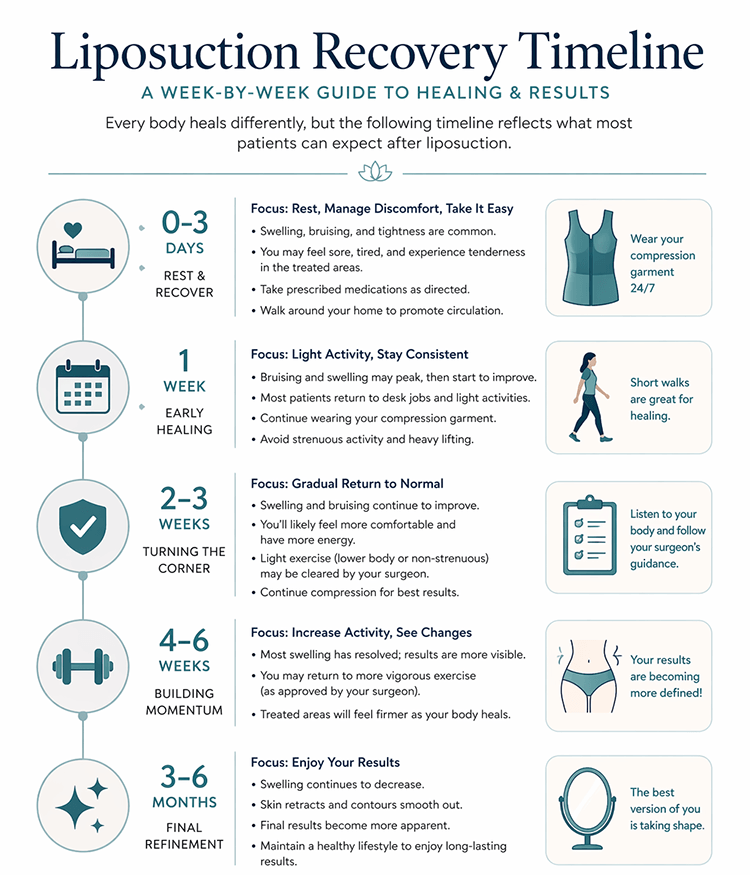
Typical Liposuction Recovery Timeline
Please note: It is important to remember that this is only a typical liposuction recovery timeline put together by feedback we’ve received from our patients. Every patient heals differently, and your recovery experience may vary based on factors such as the size and number of treatment areas, the body area treated, the volume of fat removed, the liposuction technique used, whether other procedures were also performed, your anatomy, and your body’s natural healing response.
First 24 Hours Following Surgery
How You’ll Feel
Most patients feel sore, swollen, tired, and somewhat groggy as anesthesia or sedation wears off. Liposuction discomfort is often described as soreness, tenderness, stiffness, or a “deep bruise” feeling rather than sharp pain. Any pain or discomfort can be addressed via prescribed pain medication.
How You’ll Look
Treated areas will usually look swollen and bruised right away, and some fluid drainage from the small incision sites can be expected during the early recovery period. Most patients will typically go home wearing a compression garment, elastic wrap, or other supportive dressing to help control swelling and support the tissues as they heal.
Things You Can Do
Your main priorities should be resting, staying hydrated, taking medications exactly as directed, and walking short distances around the house if your surgeon recommends it. Gentle walking supports circulation and may help reduce stiffness during the earliest stage of recovery.
Things You Can’t Do
You should not drive (patients will require someone to drive them home after surgery), lift heavy objects, exercise, or do anything strenuous during the first 24 hours. Most patients will benefit greatly from having someone help them with tasks around the house for the first few days following the procedure.
1 To 3 Days Following Surgery
How You’ll Feel
This period is often cited as having the highest degree of pain and discomfort. Patients say swelling, bruising, tightness, and soreness feel most noticeable. Treated areas may feel tender, firm, numb, or uneven, which is common early in healing.
How You’ll Look
The body may look puffier than expected during the first several days because swelling can temporarily mask contour improvements. Bruising is usually more visible during this stage, and drainage from the incision sites may still be present depending on the technique used and the extent of treatment.
Things You Can Do
Continue resting, wearing your compression garment as directed, drinking plenty of water, and taking short walks throughout the day. Careful incision care is also important during this stage, and patients should follow all instructions regarding dressing changes, showering, and monitoring for abnormal drainage. Some patients who work in non-strenuous careers (desk jobs) may feel well enough to return to work around 3 days post-op.
Things You Can’t Do
You should still avoid strenuous activity, heavy lifting, vigorous bending, and any exercise that increases swelling or puts stress on the healing tissues. Overdoing it too early can prolong swelling, worsen bruising, and interfere with healing.
1 Week Following Surgery
How You’ll Feel
By the end of the first week, many patients notice that discomfort is becoming more manageable. Soreness, bruising, and swelling are still common but begin to subside. Pain levels are usually improved and everyday movement tends to feel easier.
How You’ll Look
You will likely still have visible swelling and bruising, but the earliest signs of improvement may begin to show. The treated areas can still look uneven or firmer than expected at this stage, which is normal and does not reflect the final result.
Things You Can Do
Many patients return to work and other light activities within a few days to 1 week, depending on the extent of their procedure and how physically demanding their job is. A follow-up appointment is common around this time so the surgeon can evaluate healing, check the incisions, and review garment use and activity restrictions.
Things You Can’t Do
High-impact workouts, lifting, and strenuous exercise are still off-limits. Even if you feel better, swelling is still active and the body is still healing internally.
2 To 4 Weeks Following Surgery
How You’ll Feel
Most patients feel substantially better during this period. Pain is often minimal by this point, though some swelling, tenderness, firmness, or numbness may still persist depending on the treatment area.
How You’ll Look
By week 3, bruising is usually fading significantly, and swelling (while still apparent) is beginning to come down enough for the results of the procedure to begin being visible. Typically, incisions are also fully healed. However, treated areas may still look somewhat swollen, uneven, or firmer than the final outcome.
Things You Can Do
Most patients can return to normal daily routines during this stage, and many can begin light to moderate exercise after about week 3 if cleared by their surgeon. Compression garments are often still recommended during this phase because they help reduce swelling, support lymphatic drainage, and encourage the tissues to adapt to their new contours.
Things You Can’t Do
You should still avoid high-impact exercise and anything your surgeon has not yet cleared, especially if swelling remains significant or multiple areas were treated. Returning to strenuous movement too quickly can prolong swelling and negatively affect healing.
1 To 2 Months Following Surgery
How You’ll Feel
By this stage, most patients feel close to normal in day-to-day life. Lingering soreness is usually minimal, though mild swelling or firmness can still persist in some areas.
How You’ll Look
Most visible bruising is gone, and much of the swelling has resolved. Treated areas typically look more refined, smoother, and closer to the final result. However, it could take up to 6 months after your liposuction procedure for the final end result as the body needs time to settle into its new contours.
Things You Can Do
Many patients are cleared to resume more vigorous exercise and most normal activities around the 4-to-6-week mark, depending on healing progress. Most patients are cleared to stop wearing compression garments as well.
Things You Can’t Do
By the 6-week mark all restrictions are often greatly reduced, but patients should still follow their surgeon’s instructions regarding exercise progression, scar care, and long-term healing. Final contour improvements often continue to develop over the next several months.
Procedure Factors That Influence Liposuction Recovery
Beyond patient centered factors like pain tolerance and healing response, there are procedure specific factors that play a factor in recovery length. In general, liposuction procedures involving larger treatment areas, more fat removal, more tissue trauma, or multiple combined procedures tend to involve more swelling, bruising, and downtime:
Size and number of treatment areas
Treating one small area is typically easier to recover from than treating multiple areas or larger body regions in one session. Larger treatment surface areas usually equate to more swelling, bruising, compression needs, and overall healing time.
Quantity (volume) of fat removed
Higher-volume liposuction often creates more tissue trauma and more post-operative swelling than smaller-volume contouring procedures. To put it plainly, patients who remove higher amounts of fat often need more downtime and may see their final result take longer to emerge compared to patients who remove a small amount of fat.
Liposuction technique used
Different liposuction techniques can affect swelling, drainage, and early recovery. Traditional (tumescent) liposuction is often more invasive compared to laser liposuction (like SmartLipo) or ultrasound assisted liposuction (Vaser Lipo). More internal tissue disruption may lead to more soreness, bruising, and longer healing.
Combining liposuction with other procedures
Liposuction can often be performed along with other body contouring procedures like a tummy tuck, fat transfer, or body lift which usually leads to a longer and more involved recovery than liposuction alone. Combined procedures typically mean more swelling, more activity restrictions, and a longer downtime.
Treatment area location
The liposuction recovery experience can also vary depending on which area of the body was treated. Liposuction performed on areas that are used often or exposed to more movement and pressure (like the abdomen, flanks, thighs, arms, or under the chin) can sometimes take longer to fully heal and feel comfortable.
Liposuction Recovery Tips
Following these simple lipo recovery tips can help minimize discomfort, support proper healing, and improve your final result:
- Follow all provided post-operative instructions: This is the single most important factor in making liposuction recovery as short and smooth as possible.
- Wear your compression garment as directed: Compression helps reduce swelling, support lymphatic drainage, improve comfort, and help the tissues adapt to their new contours.
- Focus on rest during early recovery: Overdoing it too soon can worsen swelling and delay healing.
- Take short walks: Gentle movement supports circulation and can reduce stiffness during the first week.
- Stay hydrated: Proper hydration supports healing and may help your body manage post-surgical swelling more effectively.
- Eat a nutritious diet: Lean protein, fruits, vegetables, and fiber support tissue repair, while excess sodium and processed foods can contribute to swelling.
- Avoid nicotine and alcohol: Nicotine can impair healing, while alcohol can worsen dehydration and swelling.
- Take proper care of your incisions: Keeping the incision sites clean and dry, as instructed, helps reduce infection risk.
- Avoid non-approved supplements or medications: Some medications and supplements can increase bleeding or interfere with healing.
- Avoid strenuous exercise: Until fully cleared to do so by your provider.
- Watch for signs of infection: Keep an eye out for issues like sever pain, fever, pus drainage, persistent warmth feeling at incision sites, unusual swelling, skin color changes, and shortness of breath. Contact you provider immediately for any concerns you may have.
- Attend all follow-up appointments: These visits help ensure that swelling, garment use, incision healing, and contour progress are on track.
Liposuction Frequently Asked Questions
How long does it take to fully recover from liposuction?
Most patients are deemed fully recovered within 6-8 weeks, although it may take up to 6 months to realize the final end result (since contour changes may continue to develop for several months as swelling continues to resolve).
How painful is liposuction?
Liposuction is usually associated with soreness, tenderness, swelling, and a bruised feeling rather than severe pain. Discomfort is typically most noticeable during the first several days and then improves gradually.
How long do liposuction incisions take to heal?
Liposuction incisions are usually very small and often heal relatively quickly. In many cases, the surface healing is well underway within the first couple of weeks, though internal healing continues beyond that.
Will there be scarring?
Like any surgical procedure, liposuction can result in scarring at the incision sites. However, these incisions are typically quite small, and resulting scars are often subtle and become less noticeable over time.
Why do I need to wear a compression garment after liposuction?
Bottom line: compression garments make recovery more comfortable and they enhance lipo results! Compression garments help reduce swelling, improve fluid drainage, minimize discomfort, and support the tissues as they heal. They can also help the skin and underlying tissues conform more smoothly to the new contour.
When can I exercise after liposuction?
Short walks are usually encouraged early on, but more strenuous exercise should wait until you are cleared by your surgeon. Many patients can begin light to moderate exercise after about week 3, and resume their normal exercise regimen 6 weeks post-op.
When will I see my final liposuction results?
Some early improvement may be noticeable within a few weeks as swelling begins to go down, but final results usually take longer. More defined contour changes often become clearer over 1 to 3 months, with continued refinement possible through 3 to 6 months or longer.
When can I go back to work? Does this differ if I work a physical vs. desk job?
Many patients with desk jobs return within a few days to 1 week, with some feeling well enough in 2-3 days after surgery (especially after smaller lipo procedures). However, patients with physically demanding jobs often need more time off, particularly if their job involves lifting, prolonged standing, or repetitive movement.
What symptoms after liposuction are normal, and what signs should concern me?
Swelling, bruising, soreness, firmness, mild drainage, and temporary numbness are all common early in recovery. Worsening redness, fever, unusual discharge, severe pain, significant asymmetry, or anything that seems to be getting worse rather than better should be reported to your surgeon right away.
Maintaining Liposuction Results
Liposuction permanently removes fat cells from a specific area of the body. This does not mean that remaining fat cells cannot grow, nor does it mean you can’t gain weight in other areas.
To maintain your liposuction results, it’s important you maintain your post-surgery body weight. The best way to do this is with a lifestyle that embraces healthy eating and daily movement.

Ali Shahbaz, MD FRCPC, is a Board Certified Dermatologist who received his undergraduate of Honours in Bachelor of Medical Science at Western University. He then attended The University of Ottawa School of Medicine in Ottawa, Canada. Dr. Shahbaz specializes in medical, procedural and cosmetic dermatology. He enjoys treating patients of all ages and skin types. He is a strong advocate for patient education and proactively counselling patients in the treatment and management of their skin diseases. He treats all common skin conditions such as skin cancer, acne, psoriasis, and atopic dermatitis.
Disclaimer: The contents of the Westlake Dermatology website, including text, graphics, and images, are for informational purposes only and are not intended to substitute for direct medical advice from your physician or other qualified professional.
My sister is preparing to have liposuction done sometime soon. I am really glad to hear that the recovery goes really smoothly. She has been really excited for this procedure and I can’t wait to see the results.
Thank you so much for showing me what it takes to recover from a liposuction surgery. Recently, my friend has lost a ton of weight from cutting back on his food intake and exercising every single day. Because of that, he has a lot of excess skin and fat that needs to be removed. I think that this information would be really beneficial to him because the recovery could take up to 6 weeks, just like you mentioned; however, he can start to do most things around the home pretty quickly. Thanks again for all the information, and I will make sure that he knows more about this!
My wife is wanting to lose weight very quickly and we’d heard about liposuction and how nice it can be. I liked that you had mentioned that it can be important to stay hydrated and get a lot of rest to make the healing process go by quickly. We’ll have to start looking around for a professional that can handle liposuction, and I’ll be making sure she gets plenty of rest and is hydrated along the way.
It was nice to know that it is only after six weeks after the surgery that the results of the liposuction treatment will be seen and normal activities can be resumed. My surgery is next week (in Atlanta) and I was getting really nervous but this made me feel better
I like how you mentioned that you should be close to your weight goal before getting liposuction. I totally did not know that! I was wondering what other resources you have for lipo? Can you send me more info to review
Hi Bethany, thanks for reading our post and submitting your question! We have a lot of great posts on liposuction (and SmartLipo) here: https://www.westlakedermatology.com/category/liposuction/. Also you can visit our service page for more info: https://www.westlakedermatology.com/cosmetic-procedures/plastic-surgery/liposuction-austin-tx/
Finally, if you’re in the Austin area you can always call us to setup a free consultation!
Thanks again,
WD Staff
It’s good to know that it can take 6 weeks to completely recovery from liposuction. I’m sure the first couple of weeks will be the hardest though, like you said. You should definitely make sure you take it easy during that time.
A friend of mine is going in for her first liposuction treatment next week. We don’t know anyone who’s done this before, so we aren’t sure what to expect at all. I appreciate the information in this article, it’s good to know to avoid blood-thinning drugs and caffeine after the procedure.
I’ve been trying to lose weight, but I haven’t lost much mass. Because of this, I’ve been thinking about getting liposuction. It’s interesting that liposuction can take 1-2 weeks to stop aching. Where can I learn more about liposuction and it’s pros and cons?
Hi Taylor, Thanks for reading our post and submitting your great question! You can find more info on liposuction at this page (https://www.westlakedermatology.com/cosmetic-procedures/plastic-surgery/liposuction-austin-tx/) as well as on our blog (https://www.westlakedermatology.com/category/liposuction/).
Hope that helps!
WD Staff
Hey I was also not aware of this as I thought the procedure was to be done if you were carrying extra weight so I’m confused why it suggests you to be at an ideal weight for procedure
Thankyou
Hi Orla,
Thanks for reading out post and submitting your question! Just to clarify, we always recommend perspective liposuction patients to have an in-person consultation to determine candidacy. I just want to make sure readers are not dissuaded from the procedure from reading this post. An in-person consultation with a board certified plastic surgeon or dermatologist is the only way to know if Lipo truly is for you!
Basically, liposuction is not a weight loss treatment. It’s a body contouring procedure that is dedicated to addressing isolated pockets of fat and shaping (contouring) the silhouette. Depending on specific needs and characteristics of the patient, doctors may recommend a weight loss program prior to a lipo procedure. That recommendation can differ from patient to patient (which is why the in-person consultation is very necessary).
We hope that helps!
Thanks,
WD Staff
I will say my recovery took awhile, it was more than 6 weeks before I was comfortable doing moderate physical activity. But overall I am happy with results and would do it again in a heartbeat 🙂
Thank you for sharing it was 6 wks for you. I’m going into week 4. I had an extended tummy tuck, breast reduction and lip all around. I had a mom make over. My incision pain seems ok now but the real pain I still have is I guess from the Plycation. My stomach muscles seem hard and swollen and bulge if I stand too long, it seems. Also the pain from lipo, I guess where I feel burning sensation and sometimes sharp pain around my flanks and back side.
Every thing looks great tho I’m swollen which is normal. I had no complications. I hope this week the lipo pain starts to calm down. Because of the plycation for diastasis repair and lipo, I can’t walk too long or stand too long, still.
Thanks for sharing the useful tips. Great resource for people to learn ore about the post-surgical routine.